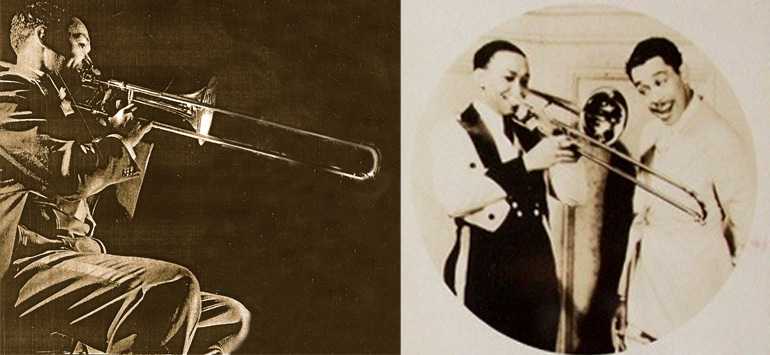
Harry ‘Father’ WHITE (1898-1962)
Trombone in the orchestra from October 1930 to February 1935
Zah Zuh Zaz, Harlem Camp Meeting, The Scat Song… All these titles bear the mark of the man the orchestra members called among themselves “Father” because he was one of the oldest: Harry WHITE (Bethlehem, Pennsylvania, June 1, 1898 – New York, August 14, 1962). And yet, when Harry put on his glasses and set about writing the arrangement scores, it was with great respect that the other musicians let him do so. This even gave rise to the song title “Father’s Got His Glasses On”. This trombonist, who had played with Ellington in the early 1920s, experienced great times. But despite his immense, versatile talent, he fell back into obscurity. The Hi de Ho Blog once again puts the spotlight on this father who was not lacking in brothers in jazz.
Promising beginnings… on the drums
At the age of 16, when other children were in high school, Harry White joined the Keith theater circuit as a drummer. He stayed there for three years before moving to Washington and taking up the trombone. His talent must have been sufficiently evident since, during local engagements, he played with Duke Ellington, Elmer Snowden, and Claude Hopkins! Nothing less!

A family of artists of five brothers (including two cousins!)
“A most musically family.” That is how the quintet formed in 1925 by the White brothers was described: Harry (tb and arr), Eddie (p and tp), Willie (tp-sax), Gil (cl and sax) and Morris (bj and g). In reality, Gil and Morris were only cousins. Does that ring a bell, Morris White? He is, in fact, the guitarist of Cab’s orchestra from the Missourians era to 1937; see our article. The group was accustomed to playing in Philadelphia and its region, with Harry still regularly going to New York to accompany June Clark, Elmer Snowden, or the drummer George Howe at The Nest (New York).
In 1927 and for almost a year, he remained in Luis Russell’s orchestra, which he left in August 1928.
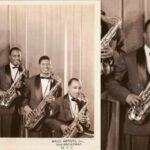
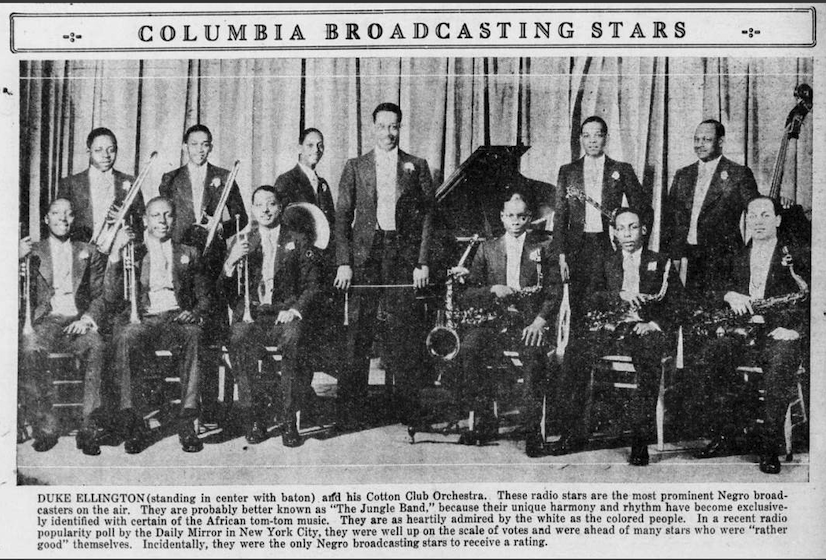
In May 1929, Harry White joined Duke Ellington’s orchestra (photo) before being dismissed and replaced by Juan Tizol (see the “Jitterbug” paragraph further on).
After his time with Ellington, Harry White led his own group again at the club The Nest in New York and then in Newark (New Jersey) during the winters of 1929-1931.
Between Cab and the Blue Rhythm Band
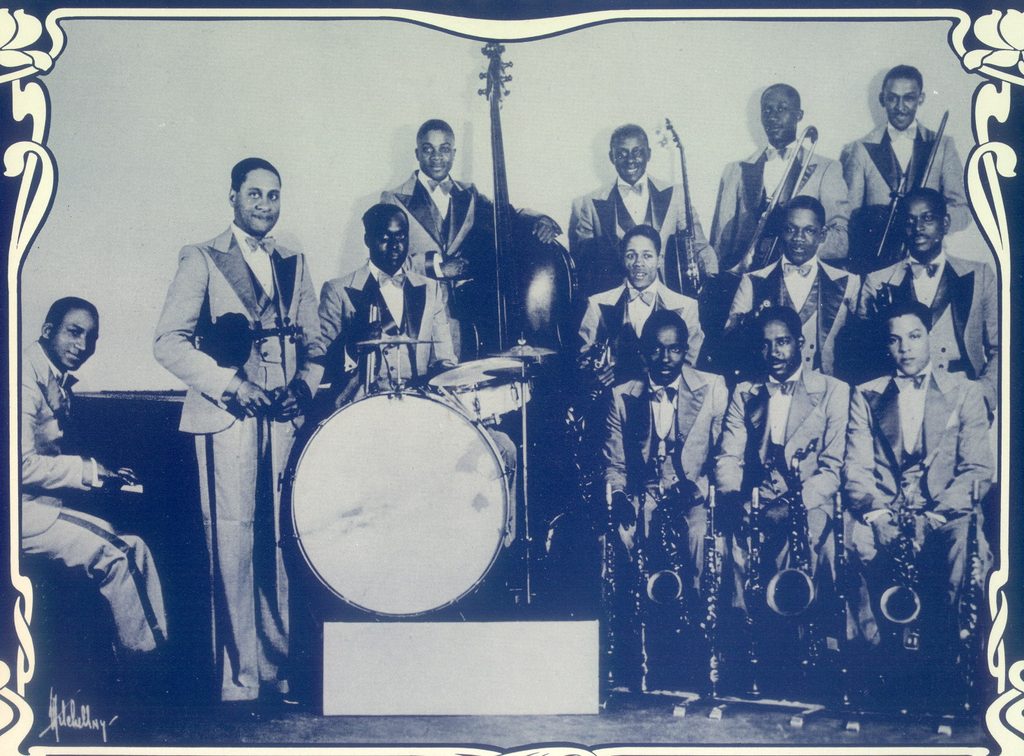
Harry participated for the first time in a recording with Cab in October 1930 but often left EB DePriest Wheeler to handle the trombone part alone, alternating his contributions with the Mills Blue Rhythm Boys orchestra. The Mills Blue Rhythm Band orchestra:
Wardell Jones, Shelton Hemphill, Eddie Anderson (tp), Harry White, Henry Hicks (tb), Crawford Wethington (cl, as, bar), Ted McCord, Castor McCord (cl, ts), Edgar Hayes (p, arr), Benny James (bj), Hayes Alvis (b), Willie Lynch (d), Dick Robertson (vcl), then George Morton (vcl), then Baron Lee (dir).
This small group was formed at the initiative of the agent and producer Irving Mills, who managed, among others, the careers of Calloway and Ellington. For this shrewd businessman, it was a matter of having a group bearing his brand, sellable at a lower price to venues that could not afford the big names. Mills could also suggest putting the Mills Blue Rhythm Band on the bill between the appearances of the stars of his stable. Clever! Later, the orchestra would pass under the leadership of Baron Lee and then Lucky Millinder.
We must not forget to mention also King Carter & His Royal Orchestra, for which Harry White recorded in March and June 1931, a group that is nothing other than 95% of the Mills Blue Rhythm Band – the only difference being Charlie Holmes on clarinet and alto sax with Carter and Crawford Wethington with Blue.
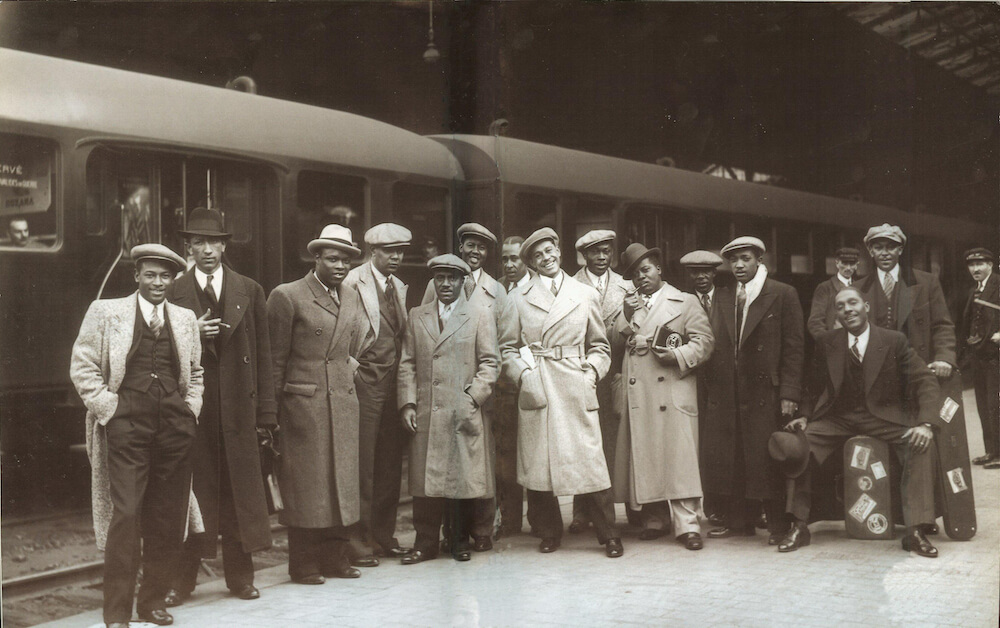
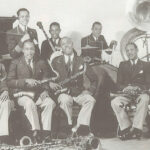
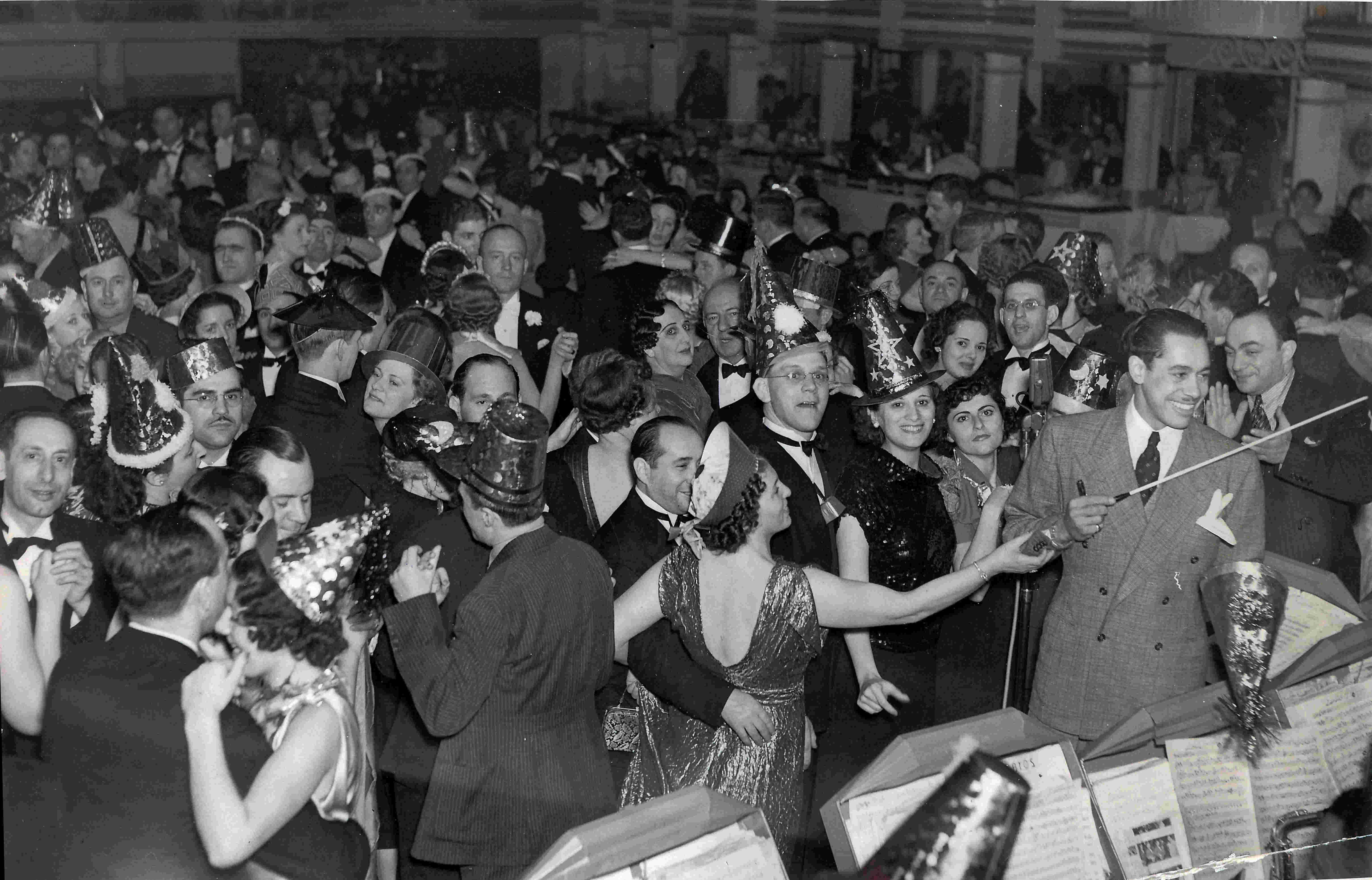
(Harry White is the 4th to the right of Cab, starting from the back)
From the session on June 7, 1932, Harry White seems to return for good to Calloway, and a second trombone is never too much! Gunther Schuller moreover considers that the addition of White was an excellent thing for the orchestra. This is reflected in particular in the sumptuous title “Evenin’”, a superb composition that Schuller judges to be very ahead of its time (except for Ellington, of course).
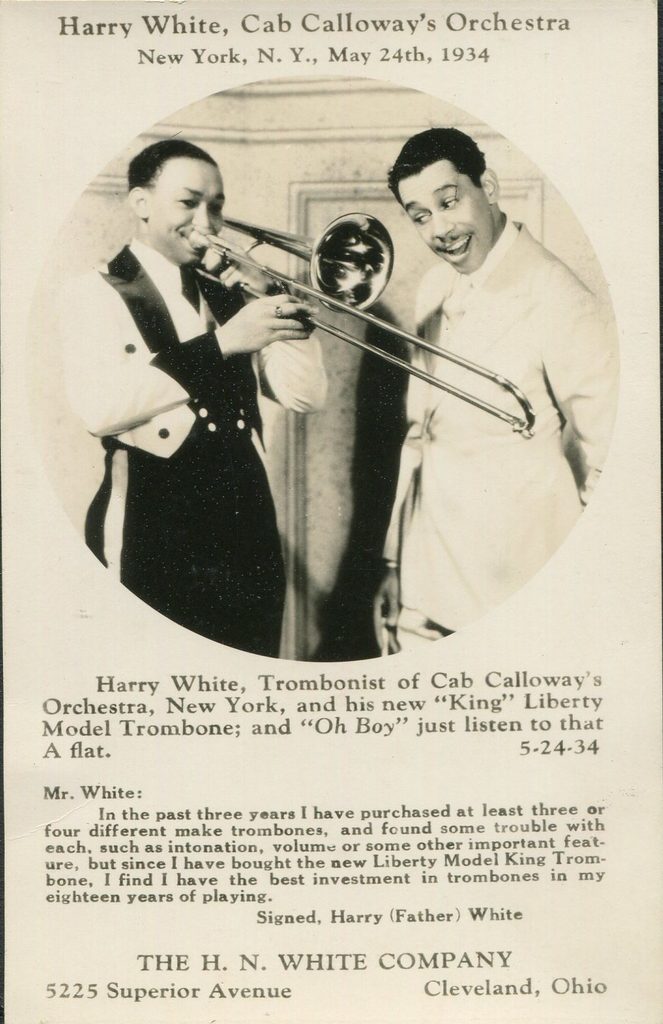
Jitterbug: another creation of Father
Even though the trumpeter Edwin Swayze composed the title (January 1934), which was a great success covered by a host of orchestras, the word “Jitterbug” is said to have been invented by Harry White. This word designates the drunkards whose gait recalls the jitterbug dancers (a dance in vogue at the Savoy Ballroom from 1926). In reality, Swayze was inspired by White’s own tendency to be a jitterbug. It was alcohol that would kill him nearly 30 years later. Moreover, alcohol caused him to be replaced in August 1929 by Juan Tizol in Ellington’s orchestra. Indeed, in an interview with Inez Cavanaugh, published in Metronome (Feb 1945), the trombonist Tricky Sam Nanton recounts that in 1929:

« Harry White came into the band for four or five weeks… You remember Father’ White, of the famous White Brothers Orchestra of Washington … well, don’t let anybody tell you differently… Father White originated the word jitterbug!
He had a pet name for all his musician pals… used to call them ‘my bug.’ Whenever Father White had a solo to play, he always stepped off the stand or into the wings and took himself a big snort of what he called jitter sauce’ …and believe me, he really had ’em every day. One day, however, some practical joker hid Father’s bottle, and in his agitation to get it back and into the spot for his solo, he hollered: ‘Whoinhell took my jitterbug?’ And somehow it floated around and finally got fastened onto the lindy-hoppers… but he’s the guy who first said it. Well, Father’s jitters got everyone jittery, and he was replaced by Juan Tizol. By this time Tizol had almost put music aside. He was playing valve trombone, and nobody wanted a valve trombone and, too, he was a legit man. I don’t have to go into his work with the Ellington band here… that’s history … well known ».
In fact, White’s quasi-permanent state of drunkenness ended up boring everyone, and he was indeed replaced by Juan Tizol.
(Given that we have already covered the subject “Jitterbug” in a previous note, I invite you to find it again *by clicking on this link*).

A European tour that starts without Harry!
On February 23, when the whole troupe (wives included) leaves New York aboard the SS Majestic for the conquest of Europe on its first tour outside the USA, Harry White – declared ill – is not there. He will nevertheless leave a few days later aboard the SS Manhattan to arrive in England on March 6, missing only the first concert at the Palladium.
The English press in the voice of Melody Maker had echoed this, worried about not seeing the 2nd trombone arrive. And he would have been quite wrong not to come because the critics were rather laudatory toward him.

In Jazz Tango of May 1934, H.H. Niesen Jr reports on the concerts of Cab Calloway’s orchestra in Holland:
“De Priest Wheeler holds the first trombone post, but it is Harry White who is the important man of the section. His choruses, both sweet and hot, are marvelous. I thought I discerned in his playing the influence of Benny Morton. Freddie Johnson told me, during the evening of the Cab Calloway orchestra at the Carlton Hotel in Amsterdam, that certain phrases of Harry White greatly recalled the manner of Herbert Flemming. White also plays the trumpet very well, and even the string bass or the piano; he is therefore an accomplished musician. He composes and arranges a great deal, and some of his compositions have been recorded by the Blues Rhythm Boys and Cab Calloway. He has also played with the Blue Rhythm Boys, which is known, but – and this is less known – he was formerly in Duke Ellington’s orchestra. It is he and not Tizol whom we see in most of the photos of Duke’s orchestra that have been published.”
Further on, N-J Canetti – who did not much appreciate the performance of the orchestra and of Cab in particular in Paris – writes:
“Neither of the two trombones had the opportunity to shine, except in ‘Hot Water’, where Harry White had the brief chance to let it be guessed that he was capable of more brilliant things than those to which his role as a supporting player in Cab Calloway’s orchestra condemned him.”

A high-quality arranger between Cab and the Mills Blue Rhythm Boys
The Swiss jazz historian Johnny Simmen described Harry White’s arrangements as characterized by “the fact that the saxophonists frequently switch to clarinet”. The American musicologist Gunther Schuller completes this by indicating that he was capable each time of establishing a truly unique atmosphere. For “Evenin’”, Schuller emphasizes that Benny Payne’s intervention on the celesta in the bridge attests to an exceptional use of this instrument. As the title of this song indicates, all the harmonies and interventions of the musicians are done in pastel tones.

Despite all the bad things the first jazz historians and critics may have said, Calloway’s titles contain numerous solos, notably thanks to White’s subtle arrangements that allowed answering the leader’s scats with parts that showcased each one (for example on “The Scat Song” – score in photo, Philippe Baudoin collection). Schuller continues by recalling that in “Zah Zuh Zaz”, the arrangement shows all the musicality of the orchestra in its responses to Cab’s incantations. 1933 is decidedly a good year for White, who also signs the arrangements of the new recording of “Minnie the Moocher” and of “Kicking the Gong Around”. Here too, Schuller emphasizes the enrichments for the fetish theme of the king of Hi de Ho on the interventions of the guitar and the piano and the addition of the vibraphone: “A whole sound-world new to jazz.”
White’s name appears on several 78 rpm records or on the studio sheets. But given that he is one of the members of the orchestra, his work is trivialized (this still earns each one a few extra dollars on the payroll!). It seems nevertheless that he surpasses for a time Walter Foots Thomas, who was the “house arranger”. Harry White exercises his talents as arranger not only for Cab’s orchestra but also for the Mills Blue Rhythm Boys of which he is also a part, as we specified above. Between 1931 and August 1932, we find Harry White alternating between Cab’s orchestra and his Blue Rhythm Boys group.
Several titles of the Mills Blue Rhythm Band come from Cab’s repertoire but often then benefit from an arrangement written by White: “Minnie the Moocher”, “Minnie the Moocher’s Wedding Day”, “Reefer Man”, “Trickeration”, “Cabin in the Cotton”, “Smoke Rings”, “The Scat Song”…

When he arrives in Cab’s orchestra in 1937, Chu Berry will not be mistaken when he wishes to obtain arrangements from other groups: he will exchange those of White (or of Swayze) for those of Chick Webb, for example, plus others.
But let us return to Harry White, who leaves the orchestra at the beginning of 1935 (before March). He is replaced by Keg Johnson and Claude Jones, two fine trombone heavyweights, no doubt more in vogue at that moment, at a time when the orchestra wants to be more “swing” and when a section of three trombones forms an ideal ensemble. Unfortunately, I have not found any testimony indicating whether it was Cab or Harry who had decided to leave…
After Calloway, the future darkens for White
Harry White is then reported by the press as working for Mills Music, composing and arranging for the house artists. Between November 1935 and April 1936, he participates in studio sessions with Luis Russell’s orchestra, which is then accompanying Louis Armstrong. Then he ceases all musical activity for two years before joining a formation of the drummer Manzie Johnson. In addition to the trombone, he also plays alto saxophone there.
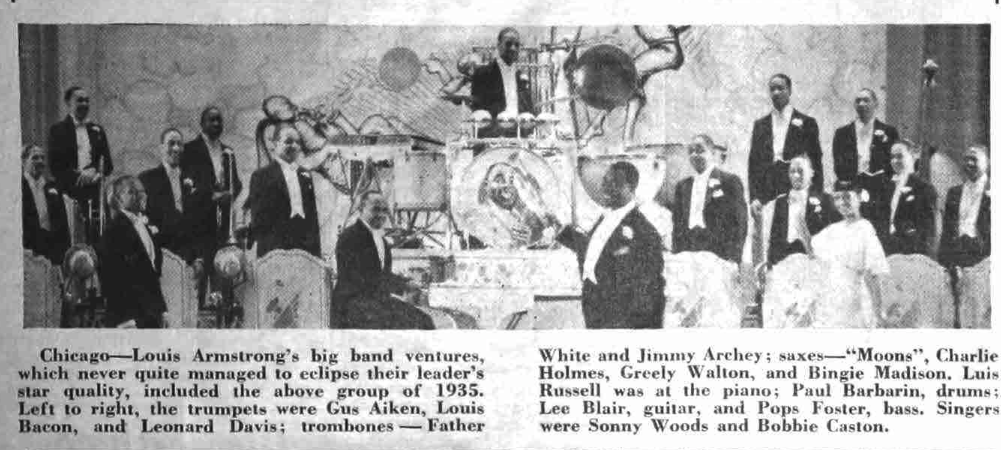
He more or less alternates periods of work on trombone and arrangements with Hot Lips Page (spring 1938) with whom he had shared the stand with Armstrong.
Then, Harry White joins as arranger the group of the tenor saxophonist Bud Freeman. His participations in the concerts of his old comrade Edgar Hayes (p) found again in 1940 were not recorded.
Harry White then suffered from a long illness that kept him away from the stands from the end of the 1930s to 1947 (with the apparent exception of a broadcast within Noble Sissle’s orchestra in November 1943).
During the war, he was enlisted on October 27, 1942 and was discharged on August 1, 1944.

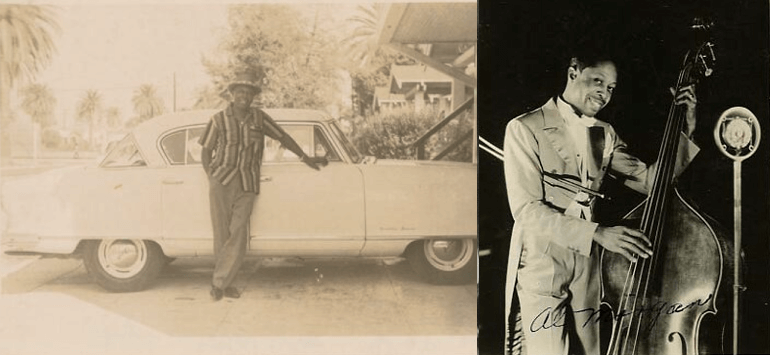
(photo taken from: The Night People)
Then, in 1952, Harry works within a Manhattan orchestra, that of Happy Caldwell at Small’s. One of the last professional engagements of Harry White of which I have found a trace is the arrangement for the titles of the session of April 22, 1959 for Dickie Wells with Vic Dickenson, Benny Morton, George Matthews (tb) Skip Hall (org, p), Kenny Burrell (g), Everett Barksdale (b), Herbie Lovelle (d) for the Felsted label. No doubt the title “Wine-O-Junction” was a homage to Harry “Jitterbug” White… By the way, White offered his small e-flat trombone to Vic Dickenson.
Since 1952, he worked in a Manhattan bank, playing gigs from time to time, until shortly before his death.
The trombonist Sandy WILLIAMS was one of Harry White’s closest friends until his death in 1962; he told Johnny Simmen that his alcoholism problems “worsened as he got older. (…) When my wife was away, I sometimes brought him home to give him a bath. I burned his worn clothes and offered him one of my suits, a shirt, etc. as well as a bottle of whisky. That’s all I could do, but I am happy to have at least been able to do that for him.”
Like many veteran musicians, Father White ended his life bitter that his contribution to jazz had been overlooked, and burdened by problems stemming from scarce work. He left no written account of his incisive opinions on jazz history, which is regrettable, but the excellence of his 1930s recordings guarantees him a lasting place in it.
Some compositions by Harry White:
- Evenin’
- Congo
- Manhattan Jam
- Chinese Rhythm
- Foolin’ With You
- Keep That Hi de Hi In Your Soul
Some arrangements by Father:
- Harlem Camp Meeting
- The Scat Song
- Jitterbug
- Zah Zuh Zaz (1933)
- Minnie The Moocher (1933)
- Kickin’ The Gong Around (1933)
- Gotta Go Places And Do Things
- Father’s Got His Glasses On
- Congo (also under the title “Harlem Congo” for Chick Webb)
- Manhattan Jam
Some (rare) solos by Harry White:
- Father’s Got His Glasses On
- Long ’Bout Midnight
Sources et references:
- Father’s Got His Glasses On – (Belated) homage to Harry Father White, Johnny SIMMEN (1986)
- Swing Era, Gunther SCHULLER
- Who’s Who of Jazz, John CHILTON
- Big Band Jazz, Albert McCARTHY
- Jazz ’Bones de Kurt DIETRICH
- Duke’s Bones de Kurt DIETRICH
- The Duke Ellington Reader, Mark TUCKER
Immense thanks to (†) Yvan Fournier and (†) Jean-Pierre Hartmann for having helped me, advised me, and provided numerous documents, without whom I could not have written this article.