Andy ‘Flat’ BROWN
(2 February 1903, St. Louis, MO – 30 January 1960, New York, NY)
alto, tenor, baritone sax, clarinet, bass clarinet in Cab Calloway’s orchestra from 1930 to the end of 1944
Andy Brown was one of the pioneers of the bass clarinet in jazz orchestras. He spent the bulk of his career under the baton of Cab Calloway, and yet here is another musician who was quickly forgotten. With the help of the few scant sources available, The Hi de Ho Blog will try to tell you a little about this unassuming musician
A childhood in Saint Louis with a fine bunch of… musicians!
Born in 1903 in Saint Louis, Andrew Jackson Brown belonged to the “old” generation of jazzmen. He was also part of the group of musicians who came from the same city, or even the same neighborhood, and who followed one another throughout their careers: Earres Prince, Eli Logan, Harry Dial, Shirley Clay…
Like Eugene Sedric and Jerome Pasquall, Andrew Brown was one of those clarinetists who received training from Mr. Langford in the Odd Fellows’ band. But that group, where instruments were lent free of charge in exchange for 25-cent lessons, also included future jazz greats such as Irving Randolph, Emmett Mathews, Dewey Jackson, Shirley Clay, R.Q. Dickerson, Leonard Davis, Harvey Langford, Andrew Luper, etc.
The legend – provided by Irving Mills’ press service – would have it that Andrew Brown worked for a time as a tailor. Well, I can hardly see when he would have found the time to cut suits given how early he entered the professional world of musicians, as the next paragraph shows.
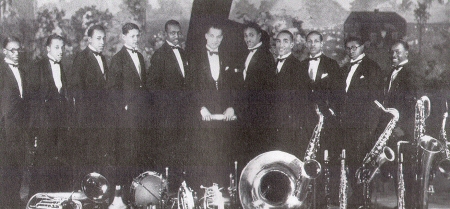
The Cotton Club orchestra under the direction of Andy Preer
(Andrew Brown is the 3rd from the left)
The hard core of Cab’s future orchestra is already forming
During the summer of 1921, we learn that Andrew Brown, Earres Prince (p), and Shirley Clay (tp) chipped in to pay the young drummer Harry Dial’s musicians’ union dues and for a new pair of trousers. They then took him for his first professional engagement. With them were the singer Ruby Barbee and the singer-dancer Clarence ‘Bobidly’ Williams. $20 a week in wages, which wasn’t bad for young musicians. Clay was replaced by Jimmy Hunter and Prince by Eddie Hudson. But the group didn’t work well and broke up at the end of 1921.
In 1922, we pick up Andy Brown’s trail once more thanks to Harry Dial’s testimony. Brown and Clay urged Dial to leave the Manhattan Café and join them at the Marigold Gardens on Olive Street Road in St. Louis. Auzie Crawford Shoffner was the group’s pianist. The place was large and elegant enough to attract a smart, numerous audience. Shortly afterwards, gangster territorial disputes forced the venue to close. We lose track of Andrew Brown somewhat at that point until the spring of 1923. That is when the violinist Wilson Robinson organized Robinson’s Syncopators around himself. This would be the hard core of the future Cotton Club orchestra, the Missourians, and finally Cab Calloway’s orchestra. As proof, here is the personnel at the beginning:
R.Q. Dickerson (p), DePriest Wheeler (tb), Earres Prince (p), Andrew Brown (cl), Eli Logan, Davey Jones (s), Jimmy Smith (b), Benny Washington (d) soon replaced by Leroy Maxey.
In 1923, the group left for the West Coast on the Pantages theatre circuit, and in 1924 continued on the Orpheum theatre circuit on the East Coast.
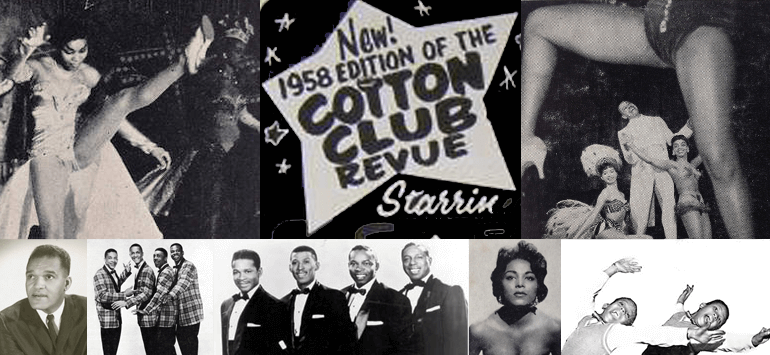
In 1925 it landed at the Cotton Club in Harlem, first under another violinist, Andy Preer, then under Eddie Lockwood Lewis. The group stayed there until 1927, when a replacement of stature was found for it: Duke Ellington.
It is interesting to read that Harry Dial ranked Andrew Brown in second place behind musicians such as Will Thornton Blue or Arville Harris, both future members of Cab’s band.
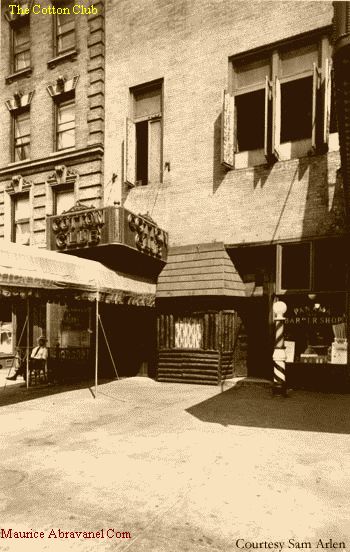
A first two-year stint at the Cotton Club
Let us go back a little, since within the Cotton Club orchestra Andrew Brown recorded a few numbers in which his tenor sax playing is featured, such as the excellent Snag ‘Em Blues (6 January 1925), Original Two-Time Man (27 April 1925) or I Found A New Baby (3 February 1927). But it was especially during the session of 3 June 1929, under the stiff direction of Lockwood Lewis, that Andrew Brown gave his best with a 30-bar solo on Market Street Stomp (even though Alyn Shipton considers that his playing, “full of control and certainty,” was a little dated even for 1929). The eminent solographer Jan Evensmo writes of him: “What a pleasant surprise! An active and very swinging style with a personal sound that makes us wonder why Andrew Brown did not become a first-rank tenor sax soloist.”

The Missourians WITHOUT Cab Calloway.
(Andrew Brown is in the front row, 2nd from the right)
The Cotton Club orchestra had therefore become the Missourians and began to make a name for itself. It was the house orchestra at the Savoy Ballroom, and it was there that it would meet its future maestro, Cab Calloway, during the famous battle of the bands that pitted them against the Alabamians led by the young Cab.
The handover from the Missourians to Cab Calloway’s orchestra has been told many times, even here. We will not go back over it, simply bearing in mind that very quickly Cab made a point of asserting his authority over the hard core of the Missourians, even if it meant rapidly replacing the rebels and reinforcing the existing group with his own choices. Andrew Brown therefore had to bow his head, rejoicing like the others at the substantial increase in pay.

The Missourians WITH Cab Calloway.
(Andrew Brown is right under the maestro…)
Promising first solos without a sequel
Within Cab Calloway’s orchestra, Andrew Brown was nicknamed ‘Flat’. This came from the fact that his speaking voice was pitched high around “E-Flat.”
On the other hand, it was rather in the low register that Flat expressed himself. Indeed, Günter Schuller recognizes him as:
“the first major black musician to have taken the bass clarinet seriously. Paul Whiteman and his orchestras that played a ‘symphonic’ dance style also used this instrument for specific effects; there are also occasional encounters with the bass clarinet (for example at the end of 1931 on Lucille with the Commodore Hotel dance orchestra). But Andrew Brown seems to have been the only player, until Harry Carney adopted the bass clarinet, to use it as a jazz instrument in its own right” (page 335).
From the very first recording of the first session under Cab Calloway’s name, Andrew Brown supports Cab with a bass-clarinet obbligato on Gotta Darn Good Reason. Effective and discreet at the same time, he allows Cab, already master of the microphone, all his flights.
He would have other opportunities such as on Some of These Days, or Somebody Stole My Gal. We also hear him on the famous Moonglow, where Eddie Barefield’s alto is the star. Flat comes in after ‘Rip’ Barefield’s elegant measures and before those of Arville Harris on clarinet.
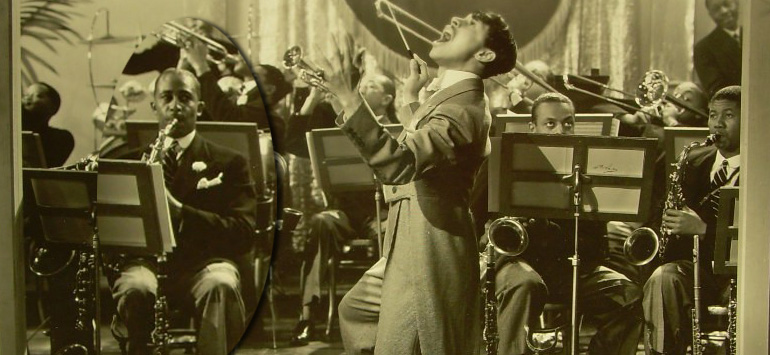
In this 1937 short film, one sees the saxophone section particularly well with Andrew Brown in the foreground.
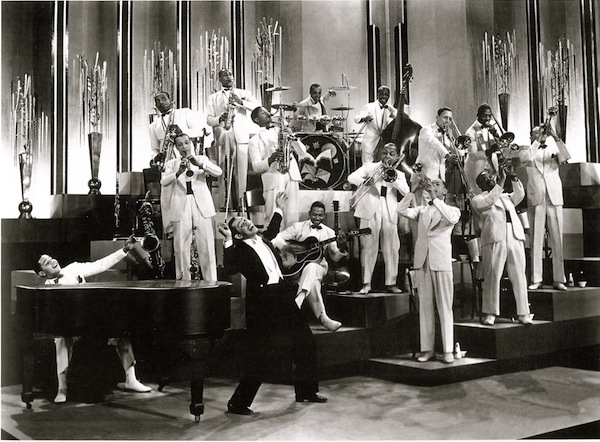
1937: to the right of Ben Webster…
A “civil servant” of the orchestra
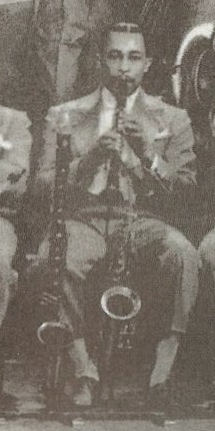
After Moonglow of 1934 one no longer really hears solos from Andrew Brown (at least I have not spotted any). He nevertheless remained an excellent member of the reed section. Some would reproach him for being a bit of a “civil servant” in Cab’s orchestra. It must be said that he had been there from the beginning and even before! The young Milt Hinton, who joined the big band in 1936, observed that a few of the old Missourians precisely looked like time-servers and never went to listen to other musicians after the concerts or tried to jam. It is true that with the intense year-round schedule one can easily fall exhausted when, after the fifth show of the day, one decides to go to bed around 4 in the morning knowing that one will have to catch the bus again right afterwards for another engagement at noon…
Year in, year out, Andrew Brown therefore stayed in Cab’s orchestra. He saw the evolution of the band. He even underwent it. Swing, new arrangements, star soloists such as Ben Webster, then Chu Berry. Everything passed, nothing tired Andrew Brown, who continued on his quiet way. The only incident, and no small one, was the car accident of 27 October 1941.
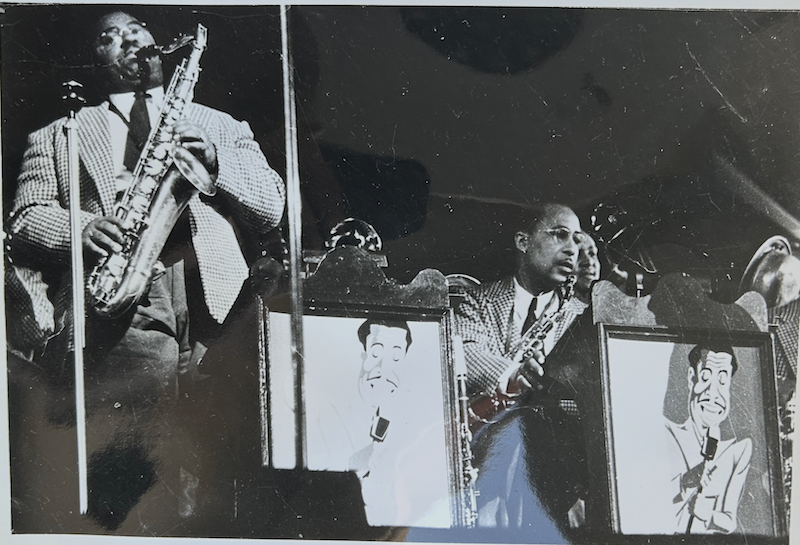
At the wheel of the car that killed Chu Berry
That evening, after their engagement in Youngstown, the whole orchestra took the bus. All except Lammar Wright, who had just bought a new car, and Chu Berry. Andrew Brown joined them and even took the wheel. Unfortunately, he fell asleep after a few kilometers, and the car smashed into the railing of a bridge in the fog. Wright and Brown were slightly concussed. Chu Berry had been thrown from the vehicle. He woke up, said a few words, fainted, and fell into a coma from which he would not wake. He died on 31 October 1941.
The orchestra did not have time to be paralyzed by grief. Engagements followed one another, and the scheduled recording sessions had to be honored. One is left wondering how Andrew Brown was thereafter perceived by Cab, who had just lost his great star.
Changes in the orchestra, even for the immovable Flat
Late 1941 was a pivotal period for Cab’s orchestra as for all the big bands. The entry of the United States into the war and the restrictions that would apply at the same time as musicians leaving for the army were going to change the face of jazz. On top of that, with young troublemakers like Dizzy Gillespie, jazz itself was about to be turned upside down. Add an evolution in public tastes, and we find Cab Calloway obliged to make his orchestra evolve as well. The Cotton Club no longer existed, and long engagements were now at the Sherman Hotel in Chicago, the Strand or the Zanzibar Café in New York. Cab needed a more “modern” sound and old-timers like Andrew Brown ended up becoming awkward, all the more so since, as we saw above, Brown was not the type to seek novelty or take risks.
In the spring of 1943, the departure of Walter Foots Thomas, a pillar of the orchestra (see our biography) and a member from the very beginning like Andrew, sounded the death knell for the old-timers. Only Lammar Wright and Brown were left. At the end of 1944, Cab Calloway had Andrew Brown’s dismissal notice delivered to him.
Alyn Shipton explained it in his book devoted to Cab Calloway: “Brown, who had spent the bulk of his adult life, nearly 20 years, in the orchestra, took it very badly. Danny Barker remembers seeing him tremble and shout after receiving his notice. ‘They took him and led him into the dressing rooms. He sat down at a table and started to cry. There were tears all the way to the floor. I have never seen a man cry like that’” (page 175).
Brown was then replaced by Rudy Powell, former sideman of Fats Waller. Dan Morgenstern finds his playing with Fats capable but inconsistent; Stephen Taylor, the Waller specialist, finds him downright bad. Be that as it may, the man who had been rather sharp in small groups now found himself in a big band that played loud with Ike Quebec at the head of the saxes!
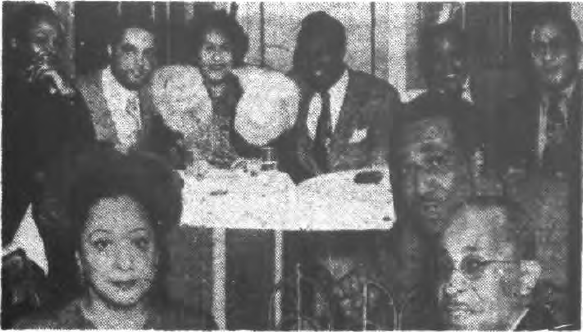
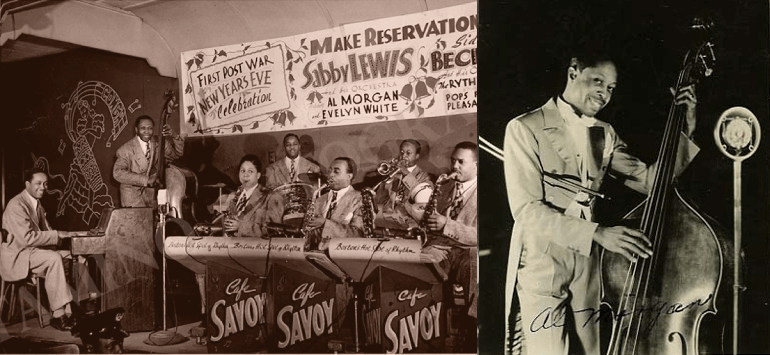
(both in the front row). 1950, New York.
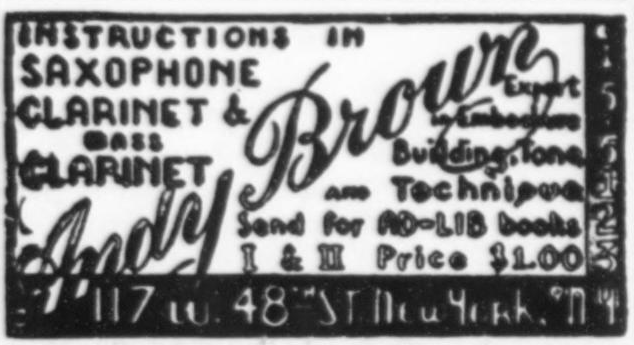
A school for reed players of all kinds and horizons
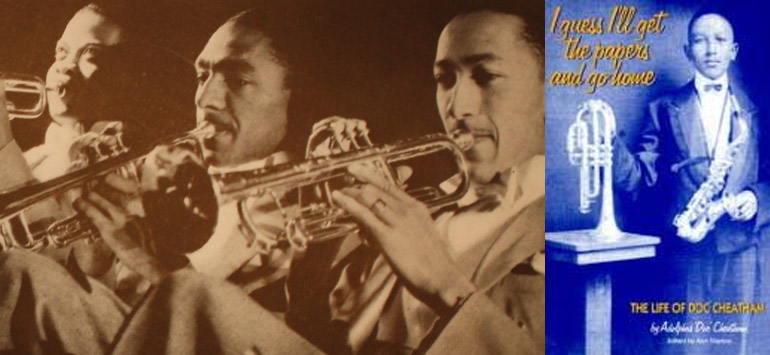
Once the tears had dried, as early as January 1945, Andrew Brown opened a school for musicians in New York, The Andy Brown Studio for Reed Instruments, at 117 W 48th Street. The same address as the studio of Doc Cheatham, Walter Foots Thomas, and Cozy Cole!
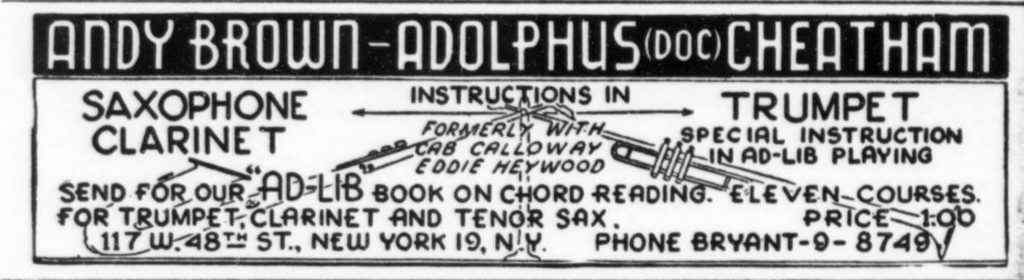
When Doc Cheatham returned to New York in 1945, Andy Brown moreover rented him one of the two rooms free of charge for a few months so that he could get back on his feet a little. Cheatham had up to 60 pupils and was then able to pay his rent to Brown. To make an appointment for a private lesson with Andy, dial CIrcle 5-5123!
In March 1956 the press announced that Eddie Barefield was going to briefly re-form a 15-piece orchestra choosing from among some thirty former members of Cab’s orchestra including Andy Brown, Walter Thomas, Chauncey Haughton, Hilton Jefferson, Garvin Bushell, Sam Taylor, Lammar Wright, Irving Randolph, Paul Webster, DePriest Wheeler, Tyree Glenn, Doc Cheatham and George Matthews (tb whose time with Cab I was unaware of). I have found no further musical trace of Andy Brown after that date.
He died in 1960 in New York, at only 60 years of age, no doubt worn out by the life of a musician on the road for more than 25 years, having had the luck to play in one of the most popular orchestras of the era and the satisfaction of having passed the torch to numerous musicians through his music school.
A few titles with which to appreciate Andrew BROWN:
- * Original Two Time Man (27 April 1925) on tenor sax
- ** I’ve Found A New Baby (3 February 1927) on tenor sax
- *** Market Street Stomp (3 June 1929) on bass clarinet (at 1:46)
- ** Vine Street Rag (1 August 1929), on tenor sax
- ** Gotta Darn Good Reason (24 July 1930), on bass clarinet
- * Some of these Days (23 December 1930), on tenor sax
- *** Somebody Stole My Gal (12 October 1931), on bass clarinet
- ** Moonglow (22 January 1934), bass clarinet solo, after that of Eddie Barefield (as) and before that of Arville Harris (cl)
- * Pickin’ the Cabbage (8 March 1940), on baritone sax
Sources :
- Grove Jazz Dictionary
- Who’s Who of Jazz, John Chilton
- All This Jazz About Jazz, Harry Dial
- History of Jazz Tenor Saxophone, 1917-1934, Jan Evensmo
- Site Fulton History
- City of Gabriels: The History of Jazz in St. Louis, 1895-1973, Dennis Owsley
- Swing Era, Gunther Schuller
- Hi De Ho, the Life of Cab Calloway, Alyn Shipton
Thanks to Stephen Taylor for his information on Rudy Powell