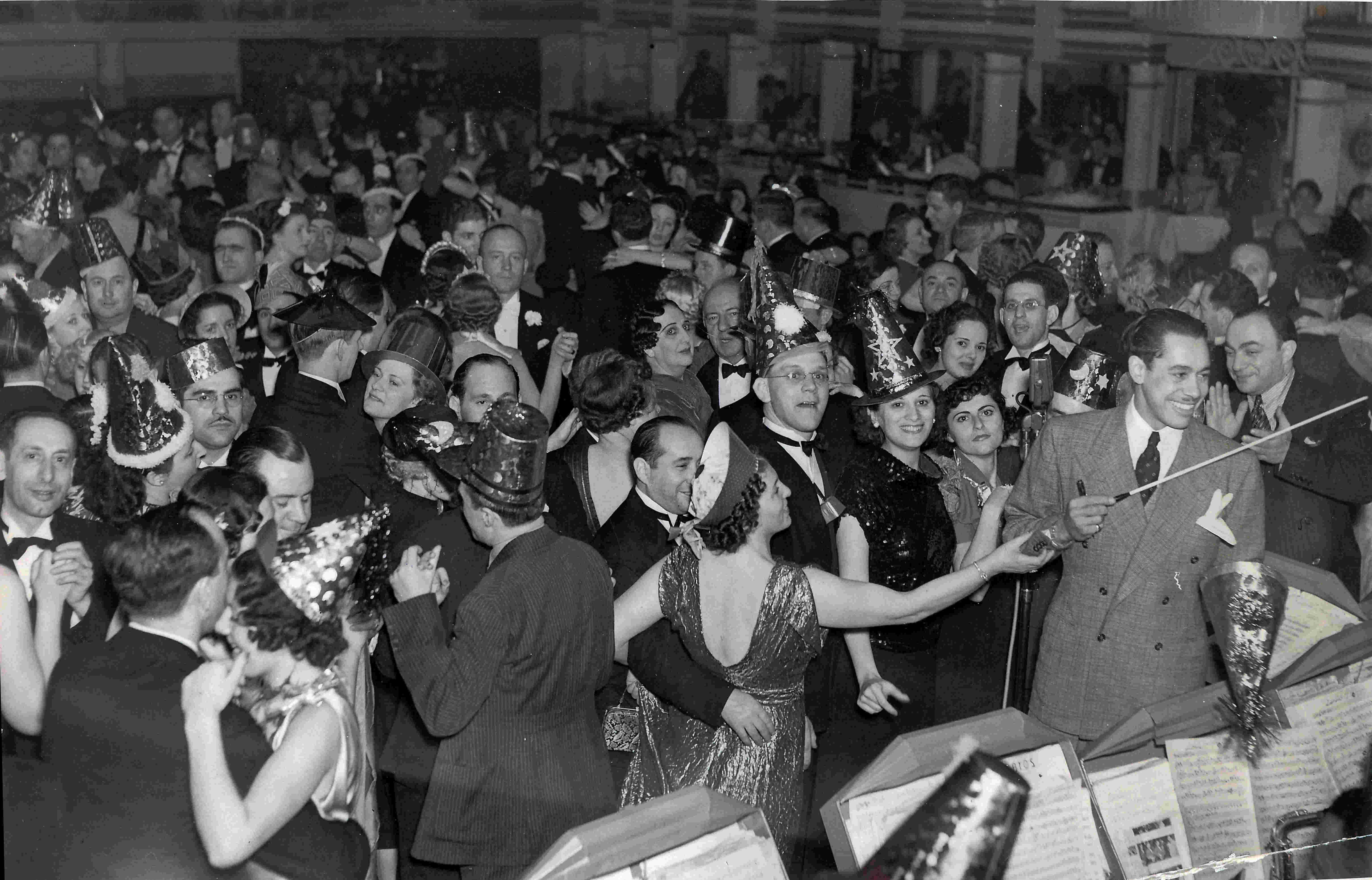
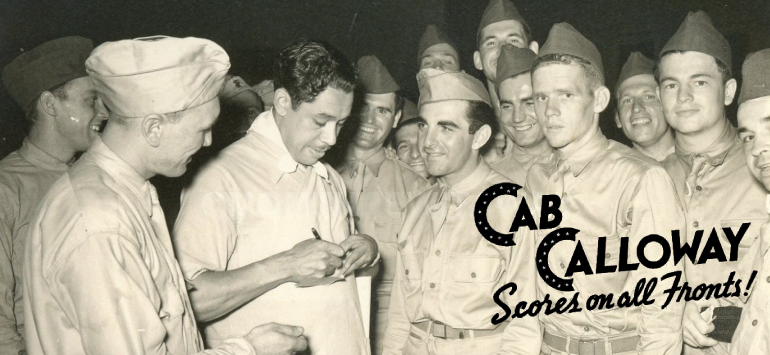
In October 1940, over 16 million American men registered for the nation’s first peacetime draft. Cab Calloway was among them. However, as biographer Alyn Shipton revealed, Calloway was turned down by his draft board “on the grounds of a slightly enlarged heart.” Classified 4-F, Calloway’s heart may have been medically flawed, but as the line goes about his famous creation Minnie, it was as big as a whale when it came to defending his country. Barred from combat, the charismatic bandleader used his massive popular appeal to serve the nation on every front imaginable: from the bandstand to Washington’s halls of power, and from military camps to bond rallies.

Desegregating the Road: The 1942 Bus Crisis
As Peter Townsend details in Pearl Harbor Jazz (2007 – a must-read), one of Calloway’s earliest wartime battles was fought right on the home front. Gas and tire rationing, followed by strict military bans on charter buses, threatened to dismantle the touring economy of Black big bands. White bands frequently secured long-term “location spots” at major hotels and venues; Black bands, systematically excluded from these residencies, relied almost entirely on eight to ten months of relentless one-night stands across the country. Without buses or private cars, Black musicians faced total financial ruin.
Though Calloway was prosperous enough to travel in his own private Pullman train or bus, he refused to stand idly by. He joined a delegation lobbying the Office of Defense Transportation in Washington, D.C., becoming a key spokesperson for Black musicians. At a press conference on July 25, 1942, Calloway forcefully laid out the realities of racial prejudice in the entertainment industry, warning that the travel ban would wipe out mid-level Black bands and severely cripple top-tier acts. His advocacy earned him formal commendation from the Negro Actors Guild.

“It’s for Our Boys”: Benefits, Canteens, and Civil Rights
Throughout the conflict, Calloway turned his orchestra into a powerhouse for war relief. He donated his time, money, and even his personal property—gifting his prized speedboat, Minnie the Moocher, to the U.S. Coast Guard in late 1942.
His wartime itinerary was relentless:
• May–June 1942: He emceed USO rallies in Harlem alongside Mayor Fiorello La Guardia, boxer Joe Louis, and Bill ‘Bojangles’ Robinson; performed benefits for Russian and British War Relief; and raised funds for the American Women’s Voluntary Services (AWVS).
• 1942–1944: He made frequent appearances at New York’s famous Stage Door Canteen, performed at the Polo Grounds alongside Irving Berlin and James Cagney, and handed out copies of his famous Hepster’s Dictionary to troops at his own expense.
• 1944–1945: Calloway took on leadership roles, accepting the chairmanship of the Canteen for Black WACs and WAVES to address the glaring lack of recreational facilities for Black servicewomen. He also headlined a Carnegie Hall benefit alongside Count Basie to fund facilities for wounded soldiers at Camp Upton, and appeared at a Glenn Miller tribute at the Paramount Theatre that raised $4 million in war bonds.

On the Front Lines of Morale: Base Tours and Segregation
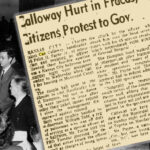
Calloway routinely took his band on USO-sponsored tours to military installations, broadcasting his popular Quizzicale radio show from sites like Bear Field in Indiana. However, Calloway refused to tolerate discrimination within the armed forces. “Cab, Duke Nix Great Lakes” … In January 1944, Calloway and Duke Ellington made national headlines when they refused to perform at the Great Lakes Naval Training Base unless they were permitted to play directly before the station’s 8,000 Black trainees.

Servicemen responded in kind. The all-Black 758th Tank Battalion named one of their armored vehicles after Calloway, while a B-25 bomber flying missions over Egypt was christened Minnie the Moocher. Across the Atlantic, spotted Alyn Shipton, Calloway’s impact took a humorous turn: British MP H. McKee complained in the House of Commons that British troops had adopted Cab’s catchphrase “hi-de-hi,” arguing it “made officers look ridiculous in the eyes of their men.”
However, Alyn Shipton judiciously remarks, “one reason that all swing bands toured, particularly by bus, was that military gigs were exempt from the gasoline ration, so that judiciously placed shows for the army could help stage the band’s progress between provincial theaters or clubs, by covering the provision and cost of the all-too-scarce fuel.”

Mobilizing the Public: War Bond Drives
Calloway was among the first major bandleaders signed by the U.S. Treasury Department to promote war bonds. During the 1943 Third War Loan drive, he famously bid $6,800 (over $130,000 in today’s currency) at an auction to buy actress Jinx Falkenburg’s tennis racket.

During the Fifth War Loan Drive in June 1944, Calloway performed for one of the daily shows on the stage of the Giant Bond Register in Times Square. Later that year, during a stop on tour in South Bend, Indiana, he braved freezing weather to headline an outdoor rally on Main Street. The South Bend Tribune reported that local teenagers skipped school to jitterbug in the streets as “Cab Calloway puts ‘jive’ to new war loan.” By May 1945, his autographed batons were fetching over $4,000 in bond sales at auctions.

Swing as a Weapon: A War Repertoire
Calloway also brought the war effort into the recording studio. In January 1943, he waxed “The Fuehrer’s Got the Jitters” for the Armed Forces Radio Service’s Jubilee show—an unusual stab at satire.
More elusive is « Rackin’ ‘Em Back, » commissioned directly by Treasury Secretary Henry Morgenthau in 1944. Written in Calloway’s signature jive, the song urged citizens to “stash your bonds away”—a slang-heavy plea encouraging Americans not to cash in their bonds early. Though heavily advertised in Metronome and co-credited to arranger Buster Harding, no sheet music or recorded performance of the track is known to survive.
Another song has been recorded but unissued, “There’ll be a hot time in the town of Berlin,” with Cab duetting with white actress Marilyn Maxwell during the NBC radio show, “For the Record,” on September 18, 1945.

(Milt Hinton on bass).
Screens on the Continent and Overseas
Calloway’s contributions extended to the silver screen. In the 1943 film Stormy Weather, designed to showcase Black artistic excellence during wartime, Calloway’s sequence with the Nicholas Brothers provided the musical climax for an audience of uniformed servicemen.
Reports from late 1943 indicated that the War Department had commissioned Calloway to film a sing-along short for troops stationed at remote outposts worldwide. It was to feature three popular numbers, ending with Cab stepping down “from the bandstand to make a personal speech to the G.I.s—reminding them that the people at home have not forgotten where they are and the job they’ve done.” Although the Signal Corps planned to “make sufficient prints for worldwide distribution,” the project ultimately never materialized.
As the war drew to a close in July 1945, Calloway traveled to Washington to lobby for a federally backed “University of Swing” – an institution designed to train discharged veterans in modern music and foster a distinctly American art form.
On August 14, 1945, during a live broadcast from New York’s Café Zanzibar, an announcer interrupted the band’s performance of “Trumpetology” to announce Japan’s unconditional surrender. World War II was officially over. But for Cab Calloway, V-J Day signaled the start of another battle: steering his big band through a rapidly changing post-war musical landscape.