Claude B. ‘Wiggy’JONES
(February 11, 1901, in Boley, OK – January 17, 1962, at sea, aboard the SS United States)
Trombone in Cab’s orchestra from 1934 to 1940, then in 1943
Here is the second part of the biography devoted to this fabulous instrumentalist, forgotten by many today but admired by all in his time. Claude Jones was an efficient and delicate musician, whose childhood and career we covered up to his arrival with Cab Calloway at the end of 1934. We are going to reunite with this lover of the good things in life and of music to evoke the years he spent with Cab, but also with Ellington, Roll Morton and others, as well as the end of his life on an American liner bound for Europe. The brilliant mixed-race trombonist had by then become a very British steward…

between Keg Johnson and the young troublemaker Dizzy Gillespie (1940)
With Cab: money, beer and a solo or two
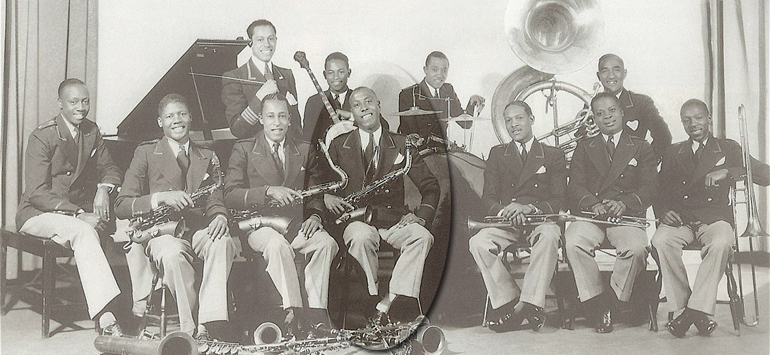
Claude Jones’s life within Cab’s orchestra resembled that of most of the other musicians: a great deal of work, travel, but also routine. Claude Jones said it himself: “I earned more money and drank more beer in Calloway’s uniform than with any other orchestra.”
One also finds him on the troupe’s baseball team (see our article on the subject). But his strength lay elsewhere. Indeed, in The World of Swing, Milt Hinton explains that Cab Calloway took into account the opinions of musicians such as Lammar Wright, Keg Johnson and Claude Jones, “because he knew they were good guys who had worked with Fletcher Henderson or in other renowned orchestras. (…) Claude Jones was unhappy because he had nothing to play.” The same observation, moreover, for Keg Johnson and Ben Webster (see our article on his period with Cab).

It even seems that Claude Jones and Keg Johnson influenced Cab in the idea of keeping Milt Hinton in the orchestra (as early as 1934, Claude had already insisted to Fletcher Henderson that he choose Ben Webster to replace Coleman Hawkins).
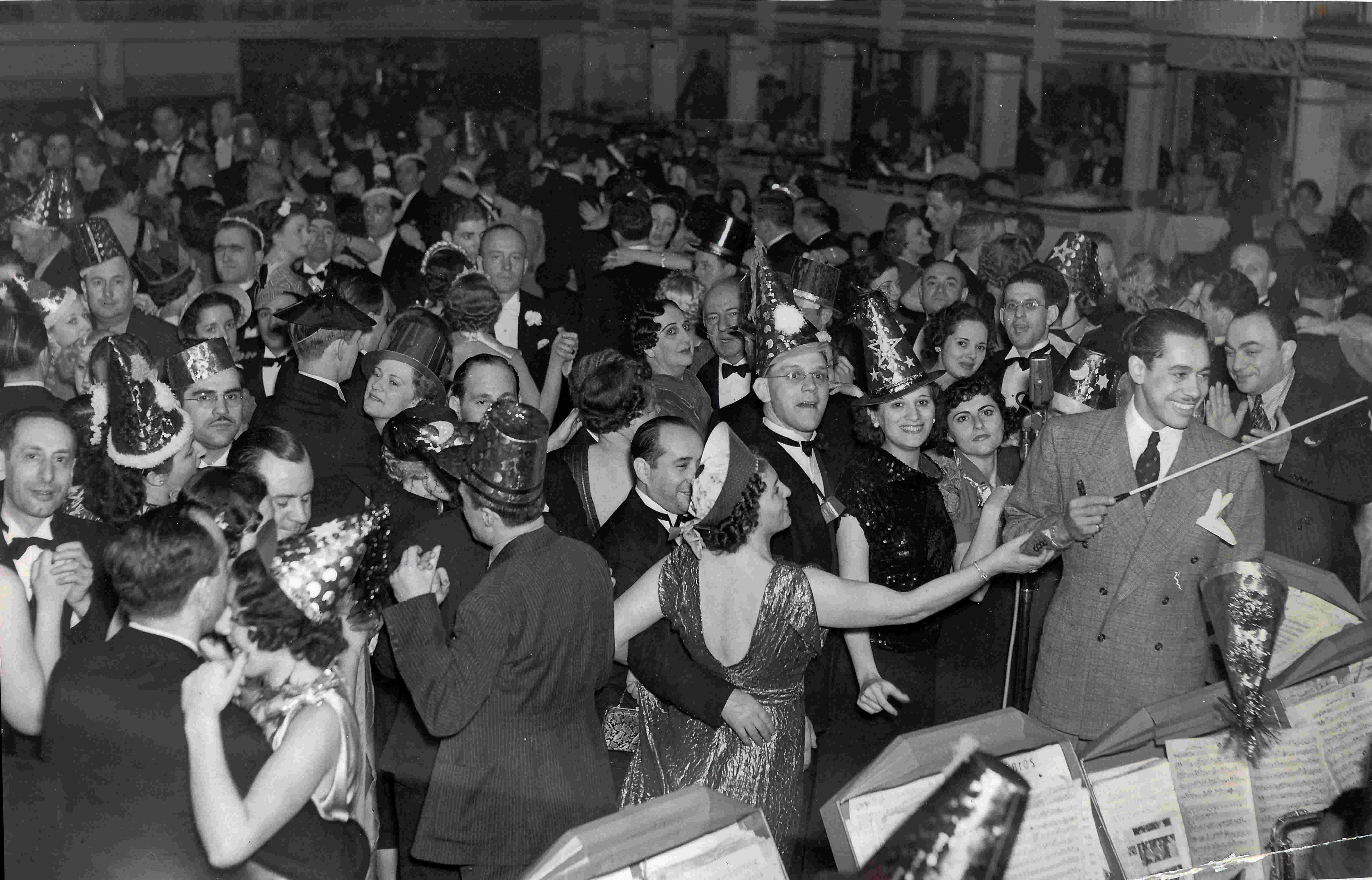
In this fine spirit of camaraderie (quite remote from what Claude would experience a few years later with Ellington), Claude Jones was indeed bored: little or no solos and the Cotton Club shows that followed one another and resembled each other every evening. There were nevertheless a few strong moments, such as the one when Claude recorded a duet with Cab on “Jess Natu’lly Lazy. » An excellent memory that was hardly noticed by the critics, the public, and jazz amateurs and/or historians. Personally, it reminds me of that famous duet between Jack Teagarden (tb) and Louis Armstrong, “Lazy Bones” (1950).
In a program of the orchestra dating from 1935, Claude Jones is presented in this way:
« First solo trombone. Born in Boley, Oklahoma. Played in his high-school orchestra. Three years at Wilberforce University, Xenia, Ohio; played in the band and the university orchestra. Musical family – his mother, aged 65, still plays the piano. Loves music but always prefers a good joke.«
A Metronome columnist writes (May 1936) about him soloing on « Nagasaki, » « Claude Jones has the appearance of a totem pole when he stands up and plays, but his tone and licks smack of genius. »

During the tours in the South of the United States where segregation reigned, Doc Cheatham recalls in his autobiography that Claude Jones could easily pass for a white man. What happened once was that Lammar WRIGHT, a trumpeter with ebony skin, spotted Claude sitting at the counter of a white restaurant, believing that he too could lunch there. Barely seated next to Claude, both of them were thrown out manu militari. Which made Jones very angry: he had not finished his breakfast!


“What’s wrong with Cab?”
That is how the newspaper Chicago Defender headlined on February 3, 1940, when the jazz world was shaken by these group departures from Calloway’s orchestra. Announced as dismissed: three trombones, Claude Jones, De Priest Wheeler, Keg Johnson; the saxophonist Chauncey Haughton; and the trumpeter Lammar Wright.
| Musician | Left for | Replaced by | Coming from |
| Claude Jones (tb) | C. Hawkins | Quentin Jackson | Don Redman |
| De Priest Wheeler (tb) | Unemployed | Tyree Glenn | Benny Carter |
| Ch. Haughton (sax) | E. Fitzgerald | Hilton Jefferson | E. Fitzgerald |
The excuse found for Claude Jones was said to have been his repeated lateness (unbearable with Calloway, as Garvin Bushell testifies). Others evoke his pronounced taste for the bottle…
The Chicago Defender journalist moreover explains that worry and a bad atmosphere then reigned in the orchestra since the drummer Cozy Cole was even talking about leaving!
What we all know now is that Cab wanted to give a new soul to his orchestra and that this went through Chu Berry, his tenor saxophonist, who had become the protégé and the star of the instrumentalists. It must be said that his reputation (and his talent) placed him at the level of the greatest of the moment, such as Coleman Hawkins and Ben Webster. We also know that Cab Calloway had already approached for some time the trombonist (and Claude’s brother-in-law) Quentin Jackson, who had refused his advances 4 times! How was this experienced in the Jones/Jackson family? No one ever complained about it in public. On the changes that were made between 1937 and 1940, therefore, read our article on Morris WHITE, the guitarist who was fired in 1939 to make way for Danny Barker.
Paradoxically, the Dictionnaire du jazz specifies that it was during his period with Calloway that Claude Jones recorded three historic sessions… but not with Cab: two with Jelly Roll Morton (1939 and 40) and the third with Louis Armstrong and Sidney Bechet (1940). Well, for the last one, it is mistaken: it was AFTER.

With Jelly Roll Morton, on September 14, 1939
Organized by Stephen W. Smith and Hugues Panassié on behalf of RCA Victor in order to relaunch Roll Morton’s career, the session of September 14, 1939 is a high point in the history of jazz (it moreover seems to be Claude Jones’s favorite session). It was a matter of gathering around the famous pianist, then forgotten by the public, some of the musicians who could best enhance his talent: Sidney Bechet (soprano sax), Albert Nicholas (clarinet), Albert Caldwell (tenor sax), Sidney de Paris (trumpet), Wellman Braud (double bass), Lawrence Lucie (guitar) and, of course, Claude Jones. The instrumentalists were placed on platforms at different heights. Bechet, who did not arrive in time to rehearse Roll Morton’s very written arrangements, rediscovered his old enemy from Nick’s Club, Zutty Singleton. As for Sidney de Paris, he showed himself very unpleasant throughout the session! The session began with “Didn’t He Ramble”, a New Orleans classic, generally struck up at the end of funerals to put the values of the deceased into perspective. The atmosphere was rather joyful in the studio, and Claude Jones was designated to play the role of the preacher: “Ashes to ashes and dust to dust, If the women don’t get you, the whiskey must.” Two takes exist of this piece in which one hears Jones notably pronounce “liquor,” more general…
On the 4 titles recorded, one hears our friend Claude Jones to satiety, notably in a duet with Sidney Bechet on “Winin’ Boy”, which Morton designated as a “pretty refrain.” Yet it is on “I Thought I Heard Buddy Bolden Say” that Claude Jones gives his best performance of the entire session.
Claude Jones would play again with Jelly Roll Morton on January 30, 1940, that is, a few days just before or just after having been dismissed from Cab Calloway. Cause or consequence? He would be among Jelly Roll Morton’s Hot Seven: Henry Red Allen (tp), Albert Nicholas (cl), Eddie Williams (as), Wellman Braud (b), Zutty Singleton (d), and Ferdinand on piano and vocals. Note: this is the ultimate session recorded by Roll Morton.

The Armstrong – Bechet duel of May 27, 1940
On May 27, 1940, Claude Jones joined in the studio Louis Armstrong, Sidney Bechet, Bernard Addison (g), Wellman Braud (b), Zutty Singleton (dms) for a Brunswick session in New York. It was a matter for the Decca company to give a sequel to the Chicago-style album it had just produced. The New Orleans style was going to be highlighted. A strange idea, finally, to add Claude Jones to the troupe, he who was not really New Orleanian and had never really claimed its inspiration (like Addison, for that matter): he even said he was the only one who did not know the pieces that were going to be played! But Louis Armstrong knew how to put him at ease. Of the four titles recorded that day, Claude Jones is present on three. If jazz historians and solographers consider that the session was historic (even if the ego questions of Armstrong and Bechet gave more the impression of a battle than of a real jam session. Bechet, who was not as well-known as Satchmo, was seen as an enemy to be brought down by Armstrong), Claude Jones keeps a mixed memory of his performance. Indeed, even though he loved the atmosphere, it was the recording conditions that upset him and harmed his solo: “Louis and Bechet were in great form that day, but the technical director really got on my nerves. He kept coming with his equipment and shouting at me, ‘Give more slide, Jones, more slide’ (Editor’s note: tailgate in English, that is the more primitive style of jazz trombone). As a result, I messed up my solo on ‘Down in Honky Tonk Town’.” Chilton, in his biography of Bechet, will nevertheless speak of “hopeful glissandos” about him.

(photo taken from John Chilton, Song of The Hawk)
Between Cab and Duke: Hawk, Zutty, Joe, Fletcher
Let us return to Claude Jones’s departure from Cab’s orchestra. Announced as leaving for Ella Fitzgerald’s orchestra, in fact, Claude Jones joined Coleman Hawkins’s group, at the same time as Billy Cato (tb) and Ernie Powell (tp). Their engagement was at the Golden Gate Ballroom, but business rapidly deteriorated as soon as the hall lost its license to sell beer to customers. The contract was “suspended” until the place could reopen. No longer being paid, Claude Jones joined Zutty SINGLETON’s group at Nick’s Club in Greenwich Village. Business picked up again, and Coleman Hawkins’s orchestra (after the latter refused to join Basie’s big band, alongside Lester Young) settled at the Savoy Ballroom in July 1940. Success was there, and the press noticed the trombone section: “I firmly believe that the trombone trio formed by Claude Jones, Sandy Williams and Billy Cato is one of the best it is given to hear at present.” (Hot Record Society Rag, quoted by J. Chilton in The Song of the Hawk, p. 176). But Hawkins always knew better how to look after women than business, and the group did not know the expected glory. Yet NBC broadcast Hawkins’s concerts three times a week throughout the summer. Among those that have been preserved, one notices a solo by Claude Jones on “California Here I Come”, a model of “brilliant sweetness” (Chilton, p. 179). In the autumn, it was the group of the pianist Joe Sullivan that Claude Jones joined. But the attraction toward Fletcher HENDERSON’s music was stronger. In 1941 and until 1942, Claude Jones stayed with the orchestra even though it was in decline. Fletcher might have provided Benny Goodman with his best arrangements in 1939; he might have been a peerless pianist; he might have lined up the best instrumentalists; success was not there.

Keg Johnson, Claude Jones, Tyree Glenn, Quentin Jackson
Return to Cab for “Stormy Weather”
On the occasion of the filming of Stormy Weather in Hollywood between January and May 1943, Cab Calloway recalled Claude Jones to the chair. I do not know the circumstances that led the trombonist to be recalled by his former employer. Perhaps one owes it to Benny Carter, who was in charge of the musical direction of the film and who was an old friend of Jones… Be that as it may, one sees Claude Jones very clearly, notably during the famous final scene on “Jumpin’ Jive” in the company of the Nicholas Brothers. The trombone section is superb, and Claude Jones is notably surrounded by his brother-in-law Quentin Jackson but also by Tyree Glenn and Keg Johnson. I cannot resist the pleasure of letting you glimpse Claude Jones’s fine wig in action, to the rhythm of the mad tap-dancing of the dancing brothers…

Claude Jones is the 3rd trombone counting from the right.

From trombone to sausage
In 1941, between two jobs with orchestras (Benny Carter, Don Redman), Claude Jones wanted to diversify his income, already beginning, no doubt, to grow weary of the world of jazz and its relentless pace. He therefore launched his little business of manufacturing and selling sausages. Unfortunately, the entry into the war of the United States on December 7 and the inherent economic restrictions and, above all, the embargo on spices coming from Japan stopped the momentum of his astonishing project… So much the better for jazz, which gained a few more years in his company there!
Claude Jones’s tips and favorites
In Music and Rhythm dated December 1941, Claude Jones shares tips for attack and execution and also gives a list of his influences and favorites:
“My own greatest influence was that of Miff Mole. Sandy Williams is another of my current favorites. But so far as most trombonists are concerned, the influence of Tommy Dorsey has been the greatest. It is easy to understand why this is the case. Tommy, whom I too regard very highly, has done more to make trombonists conscious of good tone than any other influence in popular music. Sliphorn men have concentrated on tone, however, at the expense of speed. The majority of trombonists today have acquired good tone, but speed and articulation do not get the same attention. From my own experience, I would say that a trombone can be executed just as rapidly as any other instrument. The trouble with the majority of trombonists is that they don’t spend enough time and study on the problem of attack. Phrasing, which comes naturally with the study of tone, can be supplemented with study of records; in fact, all you have to do today is play a record and get a lesson.”

With Duke, between two chairs and without valves
After recording with the young and very boppish orchestra of Billy Eckstine in April, Claude Jones was convinced by Ellington to join him during the summer of 1944 to replace Juan Tizol, who had just left. This was the first major change in the historic section of Nanton, Tizol, and Lawrence Brown. Claude Jones would remain there until 1948. He would then take part in historic recordings, such as “Black Brown and Beige”. But Mario Schneeberger has found only one remarkable solo by Claude Jones with Duke on “Tootin’ Through the Roof”, recorded during a broadcast in June 1945. That is still little to put under the slide! And yet, as the Dictionnaire du Jazz indicates, “especially influenced by Jimmy Harrison with whom he played with Fletcher Henderson, Claude Jones is however more intimate and nevertheless voluble. The sound is muted, quite comparable to that of Tommy Dorsey or Lawrence Brown. A delicate, lazy swing rises from solos, always intriguing. His fabulous technique, which prefigures the playing of the bebop trombonists, allows him to play with all the ages of classical jazz, from dixieland to Ellingtonian suites.”
So where does this absence of solos come from? No doubt from the fact that Duke Ellington wanted Claude Jones to use the valve trombone (which was not his basic instrument, but whose technique is identical to that of the trumpet, Claude Jones’s first instrument!) like Tizol. Moreover, in 1954, when Tizol would again be replaced, John Sanders (another slide trombone) had to adapt to his predecessor’s instrument and learn to play it. Duke therefore wanted to use Claude Jones with particular intentions: on a valve trombone, the attack is faster and the sound more velvety.
Dietrich, in his fabulous work Duke’s Bones, explains that despite his three and a half years with the Duke, Claude Jones was never an authentic “Ellingtonian.” He then explains the famous system of the “chairs” of Ellington’s trombone section. I take the liberty of quoting him (page 104) in full to avoid any error:
Unlike in many bands, where the chair designations imply a sort of hierarchy of importance in the section, in Ellington’s band, the chairs designated function. The first chair, occupied for many years by Lawrence Brown, included most of the highest pitched or « lead » trombone parts, as well as the solos originally designed for Brown. Joe Nanton established what became known as the « third » chair, where the plunger specialist was to sit for years. Tizol had to this point been the only occupant of what became known as the « second » chair. The parts had all been written for Tizol, including the melody lines on many of his own tunes. Not being a jazz soloist, he did not have improvised solo spots written into his parts. His relatively few solo parts were completely notated. Therefore, the few solos that appeared in the parts that Jones played with Ellington were written-out melodic solos. Recorded examples that feature Jones are the extended solo passages in Come Sunday, heard on the 1944 Carnegie Hall concert, and a chorus on Tizol’s tune Bakiff, heard on the 1947 Carnegie Hall concert.
Finally, the veterans of the orchestra certainly looked askance at the fact that “newcomers” benefited from solos that put them in the spotlight. Ellington, taking care of his troops, no doubt saw to it not to give too much space to Claude Jones, no doubt preceded by his reputation!
Dietrich estimates that the fact that Claude Jones had been relatively inactive before entering Ellington’s orchestra no doubt weighed in on his little willingness to take solos. Dietrich adds that Quentin Jackson (the brother-in-law, remember) considered that Claude Jones was not satisfied with the situation. All the more so since he explains “that there was jealousy between him [Jones] and Lawrence [Brown].”
To conclude, apparently Claude Jones’s alcohol problems did nothing to help the motivation of either party. On his problems linked to alcohol, Claude Jones remains discreet but recalls with humor that at that time Ellington had to endure the throes of the drummer Sonny Greer’s alcoholism to the point of always providing a substitute drummer for the second part of the evening. One evening, Sonny collapsed into his cymbals and drums and fell at the feet of the brass section!
During his stay with Ellington, Jones allowed himself a few escapades, notably on the side of Earl BOSTIC (as) in December 1945, where he rediscovered former Cab members: Eddie Barefield, Walter Foots Thomas and Cozy Cole.
When he left in October 1948, Claude Jones was replaced by… his brother-in-law Quentin Jackson. Claude Jones found his way back to the studios in May 1949 in Sy Oliver’s orchestra. He continued to lead a part-time musician’s life: deliberate choice or unemployment?
In 1951, Claude briefly returned to Ellington’s orchestra. Then, at the moment when Britt Woodman replaced Lawrence Brown, Juan Tizol chose to return.
Finding a little work again, Claude Jones recorded with the orchestra of the vocalist Big John Greer on April 10, 1952, where he rediscovered Irving Randolph (tp) and Tyree Glenn (tb), former Callowayians. He is also alongside Jimmy ‘Babyface’ Lewis in June of the same year. It seems that Claude Jones’s ultimate recorded session is that of October 2, 1952, in the orchestra of his old friend Benny Carter, who accompanies the singer Savannah Churchill (he would moreover find there one last time his Cab companions: Doc Cheatham, Tyree Glenn and Eddie Barefield). Afterward, Claude Jones left the world of jazz for good.
Retired from jazz
A jazz man, Claude Jones had nevertheless ended up growing weary of the universe of show business, and the last experiences had hardly contributed to convincing him to stay. After more than 30 years of good and joyful service, Claude Jones definitively took his retirement from jazz. Questioned by David Ives on the reasons for his departure, he explained that the pace of life was too difficult to follow and that too many of his comrades had cracked under the pressure: “I remember Charlie Christian, who played night and day. In fact, he played so much that he went without sleep for whole weeks. It was tuberculosis that got him for good.”

Aboard the ship SS United States
After leaving the world of jazz, Claude Jones went traveling a little everywhere in the whole world, before deciding in 1954 to become a steward aboard the brand-new luxurious liner, the SS United States. There, he said that he loved life far more than that of his musical years.
Every two weeks, the sumptuous ship sailed toward Europe, then set out again for New York, its home port. He, the old Indian of mixed blood, had “Anglicized” himself, preferring tea to coffee, having taken a taste for so-British suits without forgetting Watney’s beer!
The German jazz magazine Schlagzeug of January 1960 reports the chance meeting aboard the SS United States: “Duke Ellington had a pleasant surprise in mid-ocean. While he was dining on the boat taking him for his European tour, he was served by a man of color. Both were surprised by the encounter. The waiter was Claude Jones, who had been trombone with Ellington a few years earlier.”

At the quay, A SECOND HOME in Southampton
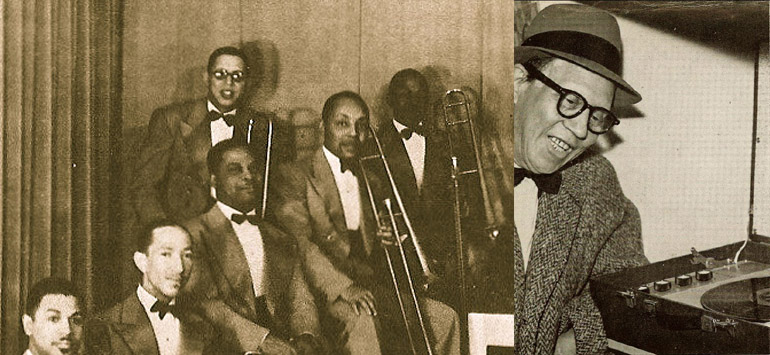
A discreet man, if ever there was one, it was only after 7 years of back-and-forth between New York and Europe that one of Southampton’s record dealers discovered who this amiable steward really was… The record dealer in question, Don Hurley, was part of a band of friends who played a lot of jazz together, had their own formation, and listened to a lot of jazz. Timid at first, Claude Jones gradually took part in the local musical life, attending recording sessions, even playing from time to time with the admiring musicians. He was even for a time president of two British organizations of jazz fans, the Hampshire Jazz Appreciation Society and the Jazz Society.
If he did not play his trombone during evenings on the cruises (Alma, Claude’s wife, remembered that her husband « tried to get on with the bands on the ship, but they don’t have colored men, » Worcester Telegram, UK, Jan 19, 1962), his instrument always remained aboard the SS United States. However, he was always happy to talk about jazz with whoever wanted to hear him. The British journalist of the Southern Daily Echo, John Edgar Mann, had even begun to collect what was to become Claude Jones’s autobiography. Thanks to him, we were able to learn numerous interesting details about the first as well as the last years of his existence, which were published in an article in March 1962.
His last voyage took place in January 1962. The SS United States left New York for Southampton. On January 17, Claude Jones had a serious attack and died a short time afterward.

Claude’s widow, Alma — a schoolteacher for mentally handicapped children in Harlem — made the trip to Southampton in October 1963 to meet all the friends his husband used to share stories and good times. A local trombonist, Keith Samuel, inherited Claude Jones’s Bach trombone.
Albert J. McCarthy perfectly describes Claude Jones’s style in the conclusion of David Ives’s article published in 1962: “Jones was not a great innovator and his stature as a trombonist did not equal that of Dickie Wells or of J.C. Higginbotham, for example. However, he was a fine musician with a style of his own, a technique and a clear ability to be able to take first-class solos. He varied his phrasing widely, often using a rapid vibrato; and his tone was full.”

in Jazz Monthly, March 1962
Notable solos for this period:
In a wonderful article titled « Salute to Jones » by Russell Sanjek and published in HRS Society Rag in September 1940, Claude Jones speaks about his solos:
« I don’t like any of them much. I did my best work with Don’s band. I liked working in 1t about the best. I guess I like that Buddy Bolden side I made with Jelly Roll about as good as any.«
With Cab Calloway
- Jess’s Natu’lly Lazy (May 21, 1936), solo and duet with Cab (to be listened to at the end of this article).
- Are You In Love With Me Again? (May 21, 1936).
- Nagasaki
- Some of These Days (1937) in the film « Hi De Ho »
- Peckin’ (March 3, 1937), one of the titles of the revue of the moment at the Cotton Club.
- Jumpin’ Jive (July 17, 1939), with a short solo “torn” from Chu Berry!
With Ferdinand Roll Morton
- Didn’t He Ramble (September 14, 1939)
- I Thought I Heard Buddy Bolden Say (September 14, 1939)
- Swinging The Elks (January 30, 1940)
With Louis Armstrong and Sidney Bechet
- Perdido Street Blues (May 27, 1940)
With Coleman Hawkins
- California Here I Come (July 1940, NBC broadcast)
With Duke Ellington
- Come Sunday (December 1944, Live at Carnegie Hall NYC)
- Things Ain’t What They Used to Be (01/17/1945, recorded in three-way link with L. Armstrong in New Orleans and B. Goodman in New York).
- Fugue-A-Ditty (January 1946, Live at Carnegie Hall NYC), in the company of Jimmy Hamilton (cl), Harry Carney (tp)
- Bakiff (December 1947, Live at Carnegie Hall NYC)
With Earl Bostic
- All On and Hurricane Blue (November 12, 1945, NYC)
Bibliographic sources for the second part:
- Bob Zieff, Claude Jones in The New Grove Dictionary of Jazz
- Kurt Dietrich, Duke’s Bones, 1995
- Stanley Dance, The World of Swing
- Gunther Schuller, Early Jazz
- Dickie Wells, The Night People
- John E. Mann: “Claude Jones: Fragment of an autobiography”, Jazz Monthly, March 1962
- David Ives, “Claude Jones”, Jazz Journal, June 1962
- David Berger, Braggin’ In Brass
- John Chilton, Song of The Hawk
- John Chilton, Sidney Bechet*
- Charles Peterson, Swing Era
This article could not have seen the light of day without the help and generosity of (†) Jean-Pierre Hartmann, trombonist and friend.
Immense thanks to Mario Schneeberger for his work on Claude Jones’s solography, which he generously completed for the occasion of this article and made available to me.
Thanks also to (†) Yvan Fournier, whose advice and inexhaustible resources are always precious to me.