Walter Foots THOMAS: the tenor sax in the Shadows (2/3)
January 23rd 2008
Walter Purl ‘Foots’ THOMAS
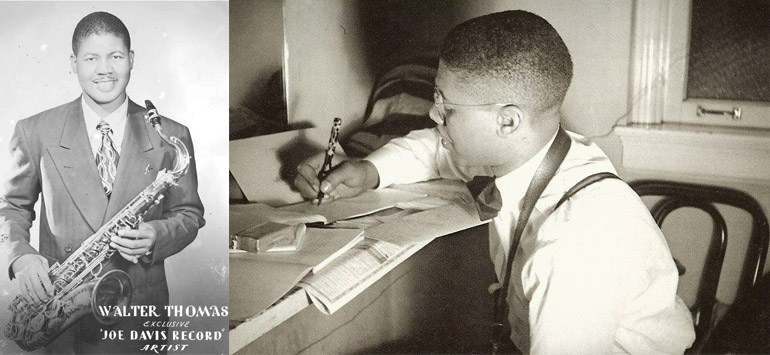
(February 10, 1907, Muskogee, OK – August 26, 1981, Englewood Cliffs, NJ) Tenor and baritone saxophone, clarinet, flute, and arranger In Cab Calloway’s orchestra from 1929 to 1943
Here is the second part of the portrait of one of Cab Calloway’s most loyal musical companions, a man about whom very little is known. Soon after Walter ‘Foots’ Thomas joined the Missourians, the band came under the sway of a newcomer: Cab Calloway. Alongside him, Thomas kept the same chair for 13 years, wearing the hats of sax section leader, arranger, musical director, and stand-in conductor whenever the boss was off the bandstand. Through it all, he hardly ever stepped out of the shadows and into the light.
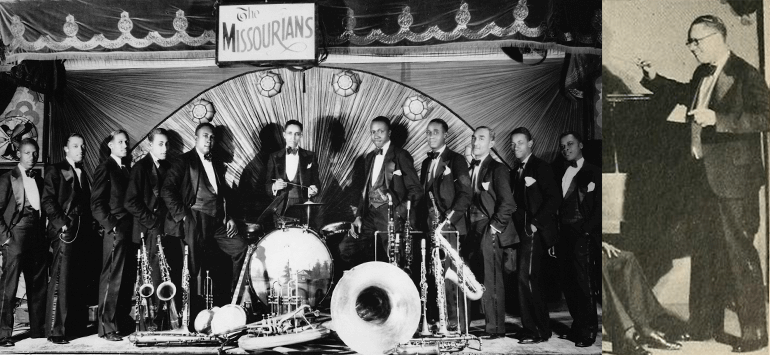
Cab Calloway and the Missourians, 1930 (Walter F. Thomas is the second on the left)
One of the Missourians’ leading men
Remember that at the session of August 24, 1930, the Missourians recorded “Prohibition Blues,” composed and arranged by Foots Thomas. His work with the band evidently impressed Cab, who gave him several solos and, above all, the arrangements for most of the numbers played by the orchestra, HIS orchestra.
From there, Thomas’s role kept growing. He led the sax section, wrote the main charts (which brought in an extra $15 to $20 per title), served as musical director and band coach, and took the baton when Cab was not on stage. Foots became Cab’s right-hand man and second-in-command, advising him on all new hires. This dynamic changed when Chu Berry joined the band in 1937: Walter rarely took solos anymore, and the person Cab relied on most became the one and only Chu.
Gunther Schuller credits him with an even bigger contribution: shaping the band’s sound in its early years. On “Black Rhythm” (August 1931), Schuller hears subtle harmonies and clever, innovative solo passages, especially in the final chorus. Always able to reinvent himself, Thomas turned “Bugle Call Rag” and above all “Some of These Days” into pieces that are just as striking some 70 years later. “Some of These Days” is one of the fastest numbers recorded up to that time (quarter note = 300)! Schuller writes:
“It is curious that this tour de force received so little recognition, then and now, particularly when compared with the runaway success of [Casa Loma Orchestra’s] ‘Casa Loma Stomp’ (recorded seventeen days earlier—at a comparatively leisurely tempo of J = 240). Not only does ‘Some of These Days’ offer quite spectacular staccato-style solos by [DePriest] Wheeler, [Andy] Brown (on tenor), [William Thornton] Blue (on alto and clarinet), [Walter ‘Foots’] Thomas (on baritone), but halfway through, the three-man saxophone section wrestles mightily with a flashy parallel-voiced ensemble chorus, almost winning the bout. [Lammar] Wright, as already mentioned, and [Wendell] Culley also soloed, the whole performance ending in a perfect coda of nine punched-out bright C-major dotted-quarter notes. Another splendid coda is contributed by Thomas in ‘Nobody’s Sweetheart,’ with its curious trumpet mini-cadenza bumping right smack into an oddly spaced chordal pyramid.”
Cozy Cole often crossed paths with Thomas in the early 1930s. As a young man, he saw Thomas come to try out his arrangements for Cab with the Rose Danceland orchestra, led by none other than Blanche Calloway (Cozy and Walter’s brother Joe were then in Cab’s sister’s band!). That let Thomas iron out the wrong notes, and in the end Blanche’s band played the same arrangements as her brother’s!
The story of “Minnie the Moocher” as told by ‘Foots’
Walter ‘Foots’ Thomas has his own first-hand recollection of the historical recording session of March 3, 1931, the disc that would become Cab Calloway’s everlasting success, « Minnie the Moocher. » He told Milt Hinton, in 1980:
“‘Hi-De-Ho’ was a public domain song named ‘Willie the Weeper.’ And [Irving] Mills got Parrish [in reality, Clarence Gaskill] to write the words to ‘Minnie the Moocher.’ He took the same lyrics and the same melody, and made it ‘Minnie the Moocher.’ That’s a story within itself. So, we got this arrangement… I wish I could think of that guy’s name. (…) He was a good arranger, but he didn’t fit what was needed – for ‘Minnie the Moocher’ anyway. So, we kept fooling with this arrangement, going over it and over it and over it. But it just didn’t make… We had enough sense to know it didn’t make sense to ‘Minnie the Moocher.’ We played at the Cotton Club. The night we closed at the Cotton Club to do the recording the next day, Cab just said, ‘Do something on ‘Minnie the Moocher.’” I went home that night, and got up early the next morning, and went to my piano — and the melody just came to me. And I’ll really confess, I copied the tune, the melody a little from ‘Get Happy.’ Because Harold Arlen was doing the show at the Cotton Club then. So, I got up the next morning, and the melody just came to me… Now, how I constructed it… I hadn’t studied harmony. But how I constructed it was a miracle. But the melody just came, then I repeated it, I repeated it again… Then I used the last two bars of ‘Willie the Weeper. ’ That’s the only thing I didn’t write.”
In another interview, ‘Foots’ Thomas also explains how, thanks to Victor Young, then house arranger of Brunswick, present in the studio, the band slowed down the tempo of « Minnie the Moocher » to turn it into the hit we know.
About « Minnie the Moocher, » he added:
“That’s when we got our break. Because we went to the Cotton Club, and we had all that air time. And man, we got so sick of playing ‘Minnie the Moocher.’ One guy used to come in the club, and if we had already played it, we had to play it again for him, Walter Winchell. Somehow, he’d get mad when he’d come in. Even though he’d come in at 10:30 or 11 o’clock, and we’d already played ‘Minnie the Moocher.’”
Arranging was also a way for Walter Foots Thomas to earn a little more. He revealed that the Cotton Club management had worked a deal with the union about the scale for their job, usually paid $120 a week, downsized to $80 a week. Considering the time and energy they spent at the Cotton Club, Foots wasn’t satisfied, and he started to « hustle. »
I didn’t know nothing about hustling. But Cab wasn’t paying me extra money to be Assistant Director. It was just a title. So I got close to the songwriters. The songwriters would come, and he didn’t have time for them. I’d take the song and I’d say, ‘Well, let us play it for a couple of days, and I’ll let you know if we can put it on the air.’ I’d pass it out and we’d play it. And I’d always check with Cab if he wanted to play it. Because it meant something for us to work with the publicists, you know. Sometimes a guy would give me fifty dollars to make an arrangement, and if I couldn’t get the fifty dollars to make arrangements, I worked out a deal every time I’d put it on the air, he’d give me ten dollars. So all I had to do was get it on five or six times.”
In the film The Singing Kid (1936), Walter Foots Thomas (right) writes the arrangements for the numbers played by Cab’s orchestra.
One last anecdote about arrangements comes from Marshal Royal, who replaced Thomas at the end of 1935, when Thomas had to write the arrangements for Cab’s songs in his forthcoming film, The Singing Kid, with Al Jolson. The stint took place at Frank Sebastian’s Cotton Club in Burbank and lasted ten days, but it let Royal play alongside Ben Webster, then in Cab’s band.
An exclusive snapshot of Walter ‘Foots’ Thomas leading Cab Calloway’s orchestra during a specialty number at Downtown Cotton Club, in 1938
Conducting the orchestra for the new Cotton Club revue!
For the Fall revue of 1938 (« Fifth Edition »), the Cotton Club writing team included J. Fred Coots and Benny Davis, plus Will H. Vodery as musical supervisor. The show featured Cab Calloway, plus the Nicholas Brothers, the Berry Brothers, Mae Johnson, W.C. Handy, June Richmond and the Dandridge Sisters, plus many other specialty acts. What was supposed to be another revue like any other turned out to be a special one for Foots:
“Then the greatest thing that happened to me at the Cotton Club, them guys who was writing the show, they saw me running out there with my saxophone when Cab would open the show. When he’d go in, I had to go out there and conduct with my saxophone. And the next show, they said, ‘We’re going to write Thomas.’ They got together with the big-shots and said, ‘We’re going to write Thomas out of the show and just let him conduct.’ Because they wanted it to be like a big Broadway show. They didn’t want me out there … I looked like a nut out there, directing with the saxophone. I could do it. I went and got me a book, and got in there and studied how to conduct. (…) That was a big break for me. »
Walter ‘Foots’ Thomas and his maestro Cab in a gorgeous movie still of « The Big Broadcast of 1932. »
A key man in Cab’s band
A veteran of the band, Foots Thomas was one of those who had Cab’s ear, and he had a good ear himself: he was the one who urged Cab to hire Doc Cheatham and Cozy Cole, among others. Cole recalls in Stanley Dance’s The World of Swing:
“We [Stuff Smith, Jonah Jones, and Cozy Cole] were working at the Merry-Co-Round over in Newark when Walter ‘Foots’ Thomas talked me into joining Cab Calloway’s band.
‘What the devil, Cozy,’ he said, ‘it’s a good job, and more stable than Stuff’s, I imagine!’ Well, namewise there were only two colored bands then: Duke’s and Cab’s. Jimmie Lunceford came up a little later, and Don Redman and others had nice names, but they weren’t big like Duke’s and Cab’s. ‘We’ll be in the Cotton Club six months of the year,’ ‘Foots’ continued, ‘and then we’ll be out on the road playing theatres. It’s a good job!’”
The sax section in 1934: Eddie Barefield, Arville Harris, Andrew Brown, Walter Thomas.
Once in the band, newcomers who were « adopted » by the veterans got protection and advice. Sax player Garvin Bushell says in his autobiography, Jazz from the Beginning, that Foots Thomas urged him to work on his sax playing rather than the clarinet, by studying with Thomas’s own teacher, Merle Johnston.
For young Milt Hinton (bass), newly hired, Foots did everything he could to convince Cab to keep him when the band reached New York, despite the trouble with the local union (a union card transfer took six months back then). A replacement bassist, Elmer James (from Chick Webb’s band), had already been hired but, according to Foots Thomas, was not up to the job. Together with Ben Webster, Lammar Wright, and Keg Johnson, Foots pressed Cab to give Milt a chance. Nobody regretted it! When Thomas left Cab’s band in 1943, it was Hinton’s turn to become musical director.
Jerry Blake, Chu Berry, Chauncey Haughton, Walter Thomas, Andrew Brown: a new fine sax section (1940)!
Once in the band, newcomers who were « adopted » by the veterans got protection and advice. Sax player Garvin Bushell says in his autobiography, Jazz from the Beginning, that Foots Thomas urged him to work on his sax playing rather than the clarinet, by studying with Thomas’s own teacher, Merle Johnston.
For young Milt Hinton (bass), newly hired, Foots did everything he could to convince Cab to keep him when the band reached New York, despite the trouble with the local union (a union card transfer took six months back then). A replacement bassist, Elmer James (from Chick Webb’s band), had already been hired but, according to Foots Thomas, was not up to the job. Together with Ben Webster, Lammar Wright, and Keg Johnson, Foots pressed Cab to give Milt a chance. Nobody regretted it! When Thomas later left Cab’s band, it was Hinton’s turn to become musical director.
Benny Payne, who tells his story in Of Minnie the Moocher and Me, learned from Foots the trick of playing syncopated, a pretty decisive step for a rhythm-section pianist!
Foots also made sure Cab never saw the “exorbitant” price paid for arrangements bought from Benny Carter, and never noticed when he swapped another band’s arrangement for one of theirs.
A veteran who listened to other jazz musicians
In July 1942 (and here it is Milt Hinton who tells the story), Cab’s band was in California, following Ellington’s. They had just left behind the young bass genius Jimmy Blanton, who was dying. Milt asked his friend Foots, a devout Christian, to go talk to Blanton and read him passages from the Bible. They arrived too late that day: Blanton was dead.
Another story from the inexhaustible Milt Hinton: Charlie Parker often came to the Cotton Club to watch Cab’s band from backstage, then talked with Cab and the musicians. Given how often he came, it is easy to imagine that the two saxophonists met… All the more so since Chan Richardson, the future Chan Parker, worked there at the time, and whenever her car broke down, Foots drove her home to Yonkers. But when Milt tells this story, he lingers on a record player he had bought on Foots’s advice, to listen to classical music or simply other jazz records after the evening’s second show. It was a clear sign of open-mindedness, surely encouraged by the band’s musical director, Walter Thomas.
An early jazz flutist
Flute parts occasionally appeared in early ragtime scores, alongside the piccolo, yet the instrument remained a rarity in jazz until the 1920s and only found its voice as a soloist in the early 1950s. Because the flute is quiet and amplification did not yet exist, arrangers hesitated to feature it. Whatever flute writing existed was usually entrusted to saxophonists such as ‘Foots,’ who doubled on the instrument. A handful of pioneers such as Wayman Carver (who later played in Chick Webb’s band) nonetheless began to make a name for themselves from the 1920s onward, even if the flute was then regarded as a novelty. Thomas, however, had another flutist close at hand: Alberto Socarras, who also played at the Cotton Club on the other side of the stage!
This Cuban clarinetist is famous for recording the earliest known jazz flute solo, “Shootin’ the Pistol,” in 1927 with Clarence Williams’s band. He went on to record with Lizzie Miles in 1928 and with Bennett’s Swamplanders in 1930. From 1936, he led his own group as the second orchestra at the Downtown Cotton Club… where the headliner was none other than Cab Calloway! Could Socarras have influenced Thomas that strongly? Anyway, in his 1978 interview for the book « Jazz Greats, » to the question « Do you think that you have been a creative jazz musician most of your life? », Walter Foots answered:
Yes, I think that I have done some things that were a bit out of the ordinary. For example, I was one of the first guys who had enough nerve to play jazz on a flute. Since I was arranging for Cab’s band, I could write in jazz flute solos for myself. I also think that I developed some creative ways of using flutes in orchestration. I learned in the early days that flutes and voices go very well together, so I used to write arrangements for singers with flutes playing harmony with the voice or playing a figure to complement the voice. I think I was able to get some beautiful effects that way.
In Cab Calloway’s autobiography, « Off Minnie the Moocher and Me, » pianist Benny Payne recalls that whenever the band was in Chicago,
« Foots would go over to a little theater in the Negro section there on the South Side, where an old man he knew played flute in the pit band. This old man made that flute sound like pure honey. Foots would spend days at a time listening to him and talking to him and learning from him. »
Aleisha Ward, in her 2009 article about Walter Foots Thomas and flute, explained that « most of the arrangements that utilize flute feature it behind the vocals or within the reeds line, » such as « Yaller, » « Down-Hearted Blues, » « Mood Indigo, » « Between the Devil and the Deep Blue Sea, » and, more audibly, as in « Bye-Bye Blues. » And she concluded:
« Although his is a small legacy, it is made particularly significant by the integration of flute into a big band setting, especially in ensemble writing, an achievement matched only by the Chick Webb band with Wayman Carver on flute, until Frank Wess began to play flute in the Count Basie band in the early 1950s. »
« Some of These Days, » (Hi-De-Ho, 1937)
Besides his 1934 solo (and duet with guitarist Morris White of « Avalon » the best example of Thomas’s flute playing remains his solo in his own arrangement of “Some of These Days,” filmed in 1937 for the short film Hi-De-Ho. The whole sequence is a pure delight, even if Ben Webster, who plays in the orchestra, does not get a solo of his own.
Listening to “North of the Mohawk Trail,” recorded on October 4, 1940, offers another chance to hear Thomas play flute at the beginning of the tune. Composed and arranged by him, it sounds like a tribute to his childhood spent in what was once Indian Territory, even though the famous trail itself (now Massachusetts Route 2) lies far from Oklahoma.
A Definite Taste for Cooking!
On tour, the guys in Cab’s band figured out how to make their own meals, since the food they found along the way was rarely any good. Milt Hinton, Lammar Wright, Tyree Glenn, and Foots Thomas took turns cooking whenever there was no restaurant nearby or the venue had a kitchen. They bought an electric hotplate, fancy enough that a carpenter built them a special trunk to carry it. The four pals cooked in rotation, and their meals became so popular that most of the band joined in!
Cleora Butler, sister of Walter Foots Thomas, in the 1930s
Cooking ran in the Thomas family, going back at least two generations. In Muskogee and later in Tulsa, the Thomases ran one of those Black-only eateries that only America could produce. The Tulsa restaurant, set in a handsome house, was known for the quality of its food, so much so that it inspired a cookbook published by Walter’s sister, Cleora Butler. Every year, Cab’s band came through Tulsa on tour and naturally took its meals at Cleora’s place. When Walter went on the road, he brought his wife along and left his son and daughter in Tulsa. He never tired of praising his mother’s cooking. No problem: she came out to cook for the whole troupe and turned Cab into one of her biggest fans!
The band, with wives and girlfriends, was in Tulsa, at Cleora’s place in June 1937, when the famous Joe Louis / Max Schmeling the World Heavyweight Championship fight happened. You can figure out the joy whe the « Brown Bomber » knocked the big German out cold in the first round…