
To make the most of the few moments of respite their tours afforded them, and to get out and meet their audiences, big bands increasingly organized sports clubs, particularly for basketball and baseball. Count Basie, Harry James, Benny Goodman, and Tommy Dorsey all had their own groups, while Louis Armstrong supported a semi-pro club from New Orleans. Baseball was also a great way to build goodwill and generate publicity.

“Take Me Out to the Ball Game,” a trend among jazz orchestras
Many white big bands had organized a sort of informal championship, in which the “Glenn Miller’s Millers” and the “Gene Krupa’s Kangaroos” took part.
Some of the white bands that had their own baseball squad:
- Gus Arnheim,
- Les Brown,
- Bob Crosby (the « Clouters »),
- Al Donahue,
- Jimmy Dorsey (« Jimmy’s Jammers »),
- Tommy Dorsey (the « Cats »),
- Benny Goodman (the « Bennyboys, » and later « Goodman’s Gargantuas »),
- Phil Harris,
- Woody Herman,
- Harry James (tenor sax Vido Musso was his star pitcher),
- Dick Jurgens (the « Jurgenauts »),
- Gene Krupa,
- Joe Marsala,
- Red Nichols (the « Nickers »),
- Will Osborne,
- Alvino Rey,
- Mugsy Spanier,
- Charlie Spivak,
- Lawrence Welk,
- Paul Whiteman (« Indoor Baseball Team »),
« Got to play ball now to join a band, » titled Down Beat (August 1, 1940), showing the importance of those teams in the music business. It is even said that Harry James—passionate about baseball, he wrote « Flatbush Flanagan » about an imaginary Dodgers’ fan—recruited saxophonist Eugene “Corky” Corcoran as much for his athletic abilities as for his musical ones! In 1944, rumors floated around about James giving up music to buy a baseball team…

Double bassist Oscar Pettiford, then with Woody Herman’s orchestra, broke his arm three or four times playing baseball under these circumstances.
Bob Crosby hosted a radio show in 1939, « Bandstand Grandstand, » with a baseball background, where the contestants were divided into two teams, with the bandleader pitching for both sides. Answers to questions are scored as singles or home runs.
Tommy Dorsey and Muggsy Spanier even recruited professional coaches for their players. Dorsey’s team was so good that Zeke Bonura of the New York Giants even wrote a raving article entitled « Baseball and Music Go Hand in Hand. »
« Inspiration for a song can come from a beautiful girl—or a baseball game » – Guy Lombardo
(The Orchestra World, March 1937)

Black orchestras, as well as most local orchestras, did the same, albeit often with more modest means:
- Louis Armstrong sponsored a New Orleans team, “Louis Armstrong’s Secret 9”
- Count Basie (whose band « Basie’s Bad Boys » was said to have an excellent “pitcher” in Lester Young),
- Duke Ellington (a 1941 home movie shows the band playing near their Pullman train)
- Fletcher Henderson,
- Les Hite,
- Andy Kirk,
- Jimmy Lunceford (tenor sax Joe Thomas had a finger broken during a game in 1941),
- Don Redman…
Mabel Scott would record « Baseball Boogie, » with some subtle double meaning…
Here’s a list of big band songs dealing with baseball
- Baseball Boogie – Mabel Scott
- Brooklyn Dodgers Cantata – Robert Merrill
- Did You See Jackie Robinson Hit That Ball? – Count Basie
- I Love Mickey – Teresa Brewer
- Joltin Joe DiMaggio – Les Brown and His Orchestra
- Let’s Keep the Dodgers in Brooklyn – Phil Foster
- Meet The Mets – Glenn Osser Orchestra
- Nobody Loves the Ump – Lucy & Desi with Bob Hope
- Robbie Doby Boogie – Brownie McGhee
- Say Hey (The Willie Mays Song) – The Treniers
- Take Me Out to the Ballgame – Andrews Sisters
- The (Brooklyn) Dodgers Fan Dance – Harry James
- The Dodgers Song – Danny Kaye


Cab, a bandleader, an athlete… and a manager
A former basketball player on his Baltimore high school team, Cab Calloway first formed a basketball squad with his band, which played mostly during the winter (we’ll explore this subject soon in a separate article). Walter “Foots” Thomas, who was a tall man, had also played on his high school team in Topeka.
In a 1942 article for Down Beat, Louis Armstrong recalled memories from his years in Chicago in the Twenties. Among the souvenirs, « Particularly, I remember playing baseball at old Washington Park. Cab singing as he pitched. »
The first mention I have found of Cab’s baseball squad dates to July 1932, when they played the Valencia Theater Team at the theater where Cab was appearing in Jamaica, Long Island. And they won that day!
Numerous jazz musicians recalled how important it was to be able to relax during the rigors of touring, with baseball providing a welcome outlet. For those who spent long hours confined to the back of a car, it was also a chance to get some exercise. Gloves, balls, and bats would come out of the trunk, and they would play wherever they could. In addition to concerts, while touring, the band often had baseball games on the schedule, usually on Sunday mornings.
On the baseball team, “Cab usually occupies the pitcher’s box, unless the opposing nine is a tough one,” wrote Ned Williams in a 1934 press manual. “Then his valet, Harold Holder, replaces him and he plays one of the bases. Cab was a star cager in his high school days and has purchased complete paraphernalia for this sport, which he and his men practice in every available gymnasium on tour. Cab Calloway and the men in his orchestra are enthusiastic athletes and play baseball in the summer and basketball in the winter regularly. They have uniforms and complete equipment for both of these sports and will be happy to challenge and play any local team, promote a game or exhibition match with a local team, colored or white, and if necessary, get a newspaper to sponsor the affair and donate the proceeds to some charity or fund.”
“At the end of the fifth inning the spectators went into the dugout, almost suffocating the leader and his teammates. All they desired was an autograph or a song,” wrote a Kansas City Star journalist in 1933.
A special truck to transport the “Jitter Bugs” squad’s equipment
As you know, Cab never did things by halves. So when he organized his squad, he bought the uniforms, gloves, and bats. During the tours, a truck was specially chartered to transport all the equipment.
When they arrived early for a concert outside the major cities, the musicians in the orchestra would meet the local club—or, better still, the players from a rival orchestra.
A short home movie shows Joe Louis visiting Cab Calloway, who was playing at Borchert Field in Milwaukee in June 1937. It offers a chance to see the team’s jacket, with “Jitter Bugs” emblazoned across the back, a reference to the famous 1935 song “Jitterbug.”
Despite all the resources put into the squad, Cab’s players were not invincible. “They’re better at music,” The Kansas City Star ironically headlined on June 29, 1933, after the musicians were defeated by a local club. Another example came in July 1942, when a team of waiters from Chicago’s Sherman Hotel faced them—and defeated them 20–4!

A full report of a game between Cab’s squad and the Chicago Defender’s team appeared in the July 20, 1935, edition of the newspaper. Claude Jones was credited with the win as pitcher!
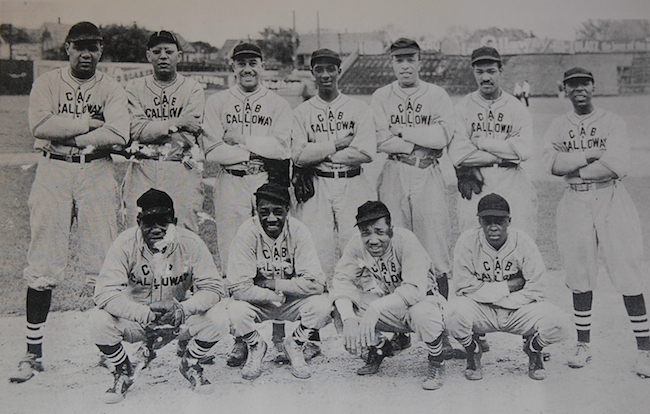
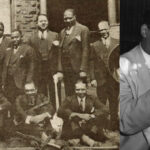
2nd row, standing: Benny Payne, Claude Jones, Cab Calloway, one of Cab’s valets, Garvin Bushell, another valet, and DePriest Wheeler.
Recollections from the musicians and players
• Milt Hinton
“We had lots of fun, Milwaukee and places like that in between shows and in the morning before the theater, we’d have a game with some local. We had this baseball team, and we did a lot of that. It was good therapy and good exercise for us, and that went on.”
• Eddie Barefield
“The workout was a good warmup for his stint with Calloway, though, for the band members supplemented their income by playing local baseball teams before each dance. The team was good enough to beat the Chicago Defenders, one of the teams in the old Negro American League. ‘We’d charge admission and split the gate,’ Barefield explained, displaying a photo of the musicians in their baseball uniforms. Standing front and center was a young and slender Calloway (‘He was already little guy then,’ Barefield said, laughing.)” (from “Old Man with a Horn,” New York News Magazine, Nov. 7, 1976)
• Milt Hinton, about E.B. DePriest Wheeler
“He’s one of those very disciplined men. He’s short. He was quite athletic. He loved baseball; in fact, we called him Mickey after Mickey Cochrane, the great catcher, because Cab had a baseball band, and Mickey was our catcher, and he took baseball very seriously.” (from Jazz Oral History Project)
This seems to have stemmed from an early passion for the game during his high school years. More about DePriest Wheeler here.
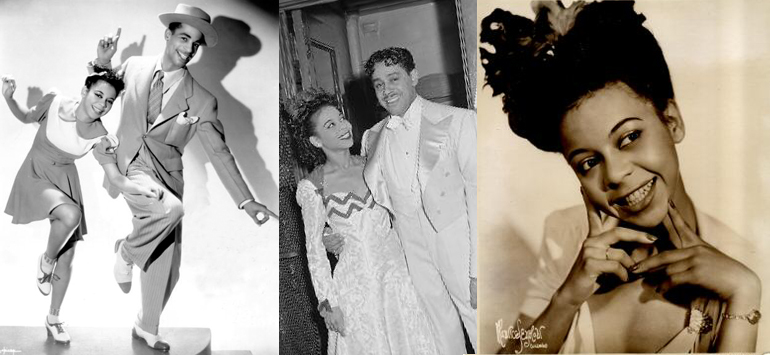
• Tap dancer Cholly Atkins
“We worked there for about two months, at least, and while we were there. Cab came to the Chicago Theater [in February 1942] downtown with his unit. I was pitching for the Rhumboogie team. Remember, Honi is still traveling with Cab, so he’s on the opposing team. Just before the game started, he came over and said, Look, when Cab comes to bat, whatever you do, don’t strike him out! » He knew I had a good fast ball because back in Atlantic City, when we had the team at the Paradise, I was the pitcher, Honi was the third baseman, Brownie played second base, and Cookie was in the outfield. Besides, Honi and I had played softball together for a thousand years!
He said, ‘I know you’re going to be throwing that little funny ball up there. His head’s gonna be bad and he ain’t hardly gonna be able to see the ball. I’m trying to get you this gig and if you strike him out and embarrass him in front of all these people out here, he ain’t never gonna hire you!’
I went up there and I started lobbing the ball up to the plate, and he was still striking at it and missing. He’d swing at the ball before it even got up there! So I finally made up my mind, I’m not going to lob this ball up; I’m just going to take everything I can off the ball and go ahead and throw it up there-and pray! So I just guided it up to the plate and sure enough, he hit the sucker past third base. Honi gave me the sign. The next time Cab came up, I threw him the same kind of pitch and he got a piece of it again, so that saved me!” [Cholly Atkins eventually joined the Calloway troupe, pairing with Dotty Saulters]

The end of the game
Milt Hinton explains how the baseball squad came to an end:
“Cab made Tyree the manager, or Tyree took over the managership. And Cab was in a batting slump. And Tyree benched Cab. He was furious. It’s his team, and his bats and his balls, and Tyree benched him! And he got so mad that he sold Tyree and the whole team for a penny, one cent.”
However, Cab continued to run his baseball squad and remained a devoted baseball fan, attending many games in the United States and even in Cuba when he was performing there. And he was always ready to put on a jacket and hold a bat for a good photo in the newspapers!

On July 17, 1949, Cab Calloway performed his cover of “Did You See Jackie Robinson Hit That Ball?” on The Ed Sullivan Show. And he won the game on screen! That makes sense: jazz is a question of swing…